
Anglo Saxon - Danish Kings, England. Cnut, Æthelric (Moneyer), 1016-1035 AD Shaftesbury, c. 1016 - 1023 AD
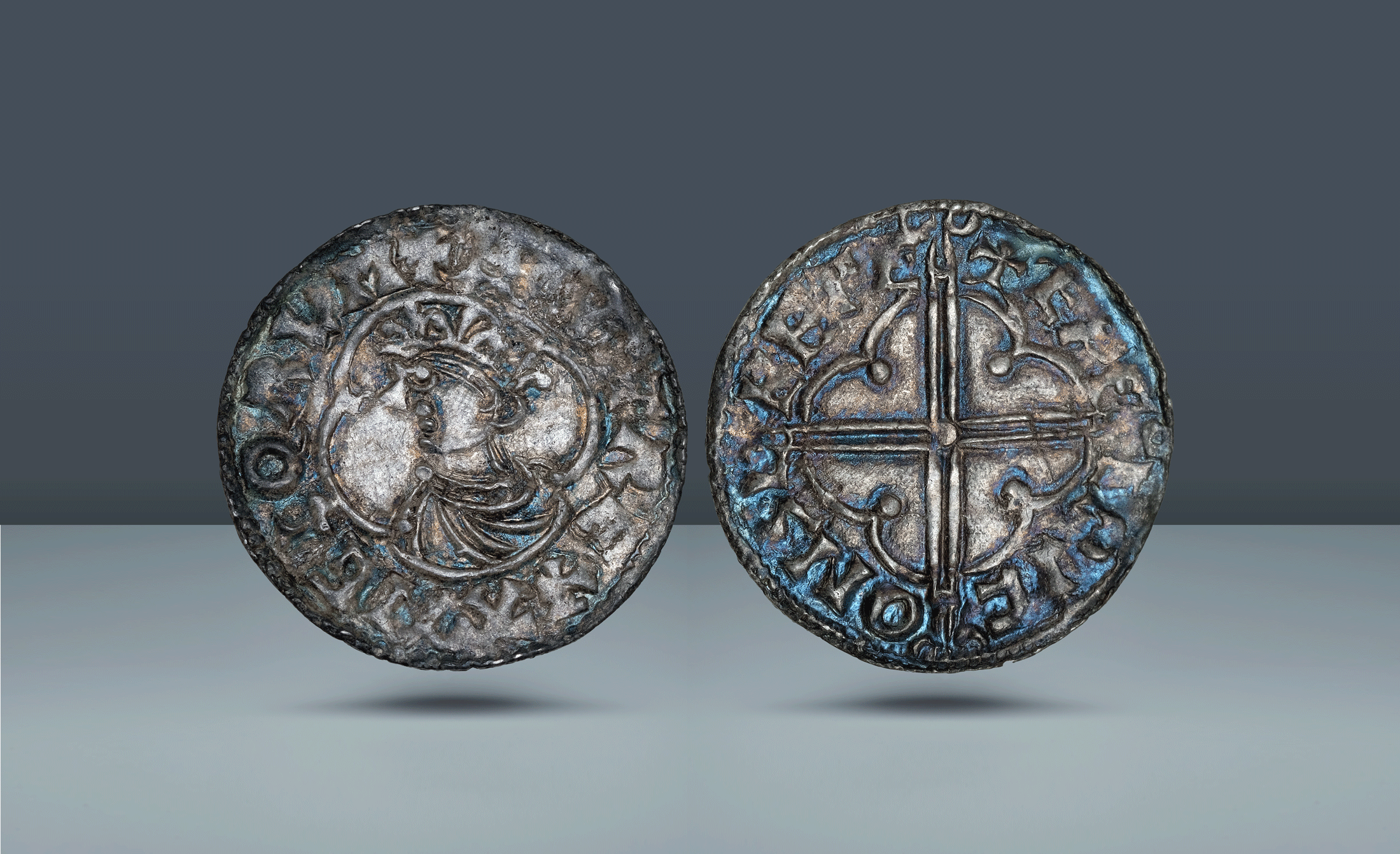
Anglo Saxon - Danish Kings, England. Cnut, Æthelric (Moneyer), 1016-1035 AD Shaftesbury, c. 1016 - 1023 AD
AR Penny, 0.98g (19mm, 9h).
Crowned and draped bust to l. within quatrefoil / Voided long cross, with triple-crescent ends and pellet at center; all over quatrefoil
Pedigree: From the L. E. Bruun Collection. Purchased privately from the Countship of Brahesminde Collection in a private sale from 1922). Accompanied with original red Bruun cabinet ticket
References: Quatrefoil (BMC viii) type, S-1157, North-781, cf. Hild-3103, SCBI Cop-3354 (plate coin), Bruun-802 (this coin)
Grade: Previously graded NGC MS-63. A sharply struck and beautifully toned example. Mint State
wc1326
Scroll down for more information about this coin.
Cnut, King of England, Denmark, and Norway from 1016 until his death in 1035, secured the English throne through a combination of military conquest and calculated statecraft following the death of Edmund Ironside, and one of his most enduring acts of consolidation was the reform of the English coinage along Anglo-Saxon lines rather than imposing a Scandinavian model. This penny, struck at Shaftesbury under the moneyer Æthelric, belongs to the Quatrefoil type (BMC viii), issued in the early years of Cnut's reign, roughly 1017 to 1023, and represents the first of the standardized coinages he inherited and continued from the late Anglo-Saxon monetary system established under Æthelred II. The obverse presents the king's crowned and draped bust in profile, framed within a quatrefoil, a design that echoes contemporary Ottonian and Anglo-Saxon aesthetic conventions and projects an image of continuity and legitimate royal authority, an important visual message for a Danish conqueror ruling an English kingdom. The reverse carries a voided long cross with triple-crescent terminals and a central pellet, the entire design again set within a quatrefoil border, a geometric harmony between obverse and reverse that is characteristic of the type's visual sophistication.
Shaftesbury, in Dorset, was an active minting center throughout the late Anglo-Saxon and early Anglo-Danish periods, its output reflecting the tight royal control over coin production that had been established under the tenth-century reforms and that Cnut was careful to preserve, since a stable and trusted currency was essential to his authority over a newly won and still-uneasy kingdom. The moneyer Æthelric, whose name appears on the reverse, was one of many local officials personally responsible for the weight and fineness of the coins struck under his name, a system of individual accountability that gave Anglo-Saxon coinage its remarkable consistency.
This coin carries exceptional pedigree, having formed part of the celebrated collection of Lauritz Emil Bruun, the Danish shipping magnate, whose holdings of Anglo-Saxon and Anglo-Danish coinage were among the finest ever assembled by a private collector and were published in the Sylloge of Coins of the British Isles volume for the Danish National Museum. In accordance with his will, the collection was to be sold 100 years after his death, which occurred in 2024 via Stacks Bowers.