
United Kingdom of Great Britain and Ireland, London. George III, By. L. Pingo, 1760-1820 AD, c. 1798 AD
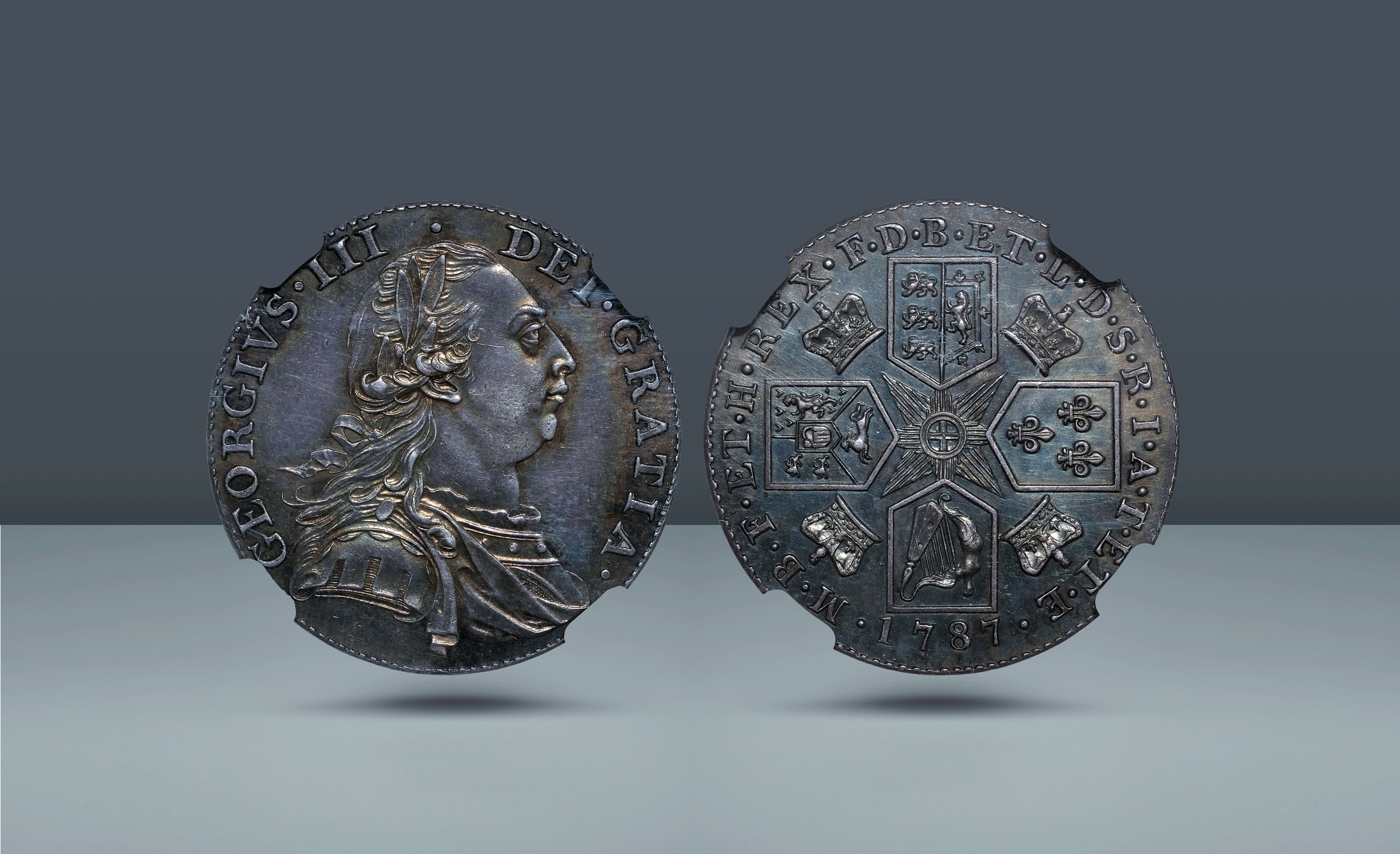
United Kingdom of Great Britain and Ireland, London. George III, By. L. Pingo, 1760-1820 AD, c. 1798 AD
AR Pattern Shilling, 5.77g (24.5mm, 1h).
laureate and cuirassed bust r., beaded outer border at raised rim both sides / inverted, cruciform shields, garter star at centre, date at bottom without stops either side, plain edge
Pedigree: Purchased from C. Wolfe, ANA December 1974
References: Bull 2139, ESC 1227, S.3747.
Grade: Graded PF63 by NGC
wc1333
Scroll down for more information about this coin.
This rare pattern shilling of George III, struck in 1798, represents an experimental issue produced during a period of monetary reform and severe coin shortages in Britain. Patterns were trial pieces struck to test new designs, denominations, or technical specifications before potential adoption for circulation. Many such pieces were struck only in very small numbers, making them highly sought after today.
The obverse features a laureate and cuirassed bust of George III facing right, engraved by the noted medallist and engraver Lewis Pingo, who served as an assistant engraver at the Royal Mint. The portrait is rendered in an elegant neoclassical style typical of late eighteenth-century British numismatic art. A beaded outer border at a raised rim frames the design, enhancing the refined appearance characteristic of proof pattern coinage.
The reverse displays an elaborate cruciform arrangement of shields, representing the arms of the kingdoms united under the British crown, with the star of the Order of the Garter at the center. The date 1798 appears below, notably without stops on either side, a detail important for cataloging this specific pattern variety. The cruciform shield composition echoes the heraldic designs used on earlier British silver coinage, while the refined execution reflects the experimental nature of the piece.
Pattern coins from the reign of George III are of particular interest to collectors because they illustrate the evolution of British coinage during the late eighteenth century, a time when the Royal Mint was exploring improved designs and production techniques prior to the sweeping reforms of the early nineteenth century.
This specimen was purchased from C. Wolfe at the ANA convention in December 1974 and is now certified NGC PF63, displaying the sharp strike and reflective surfaces expected of proof pattern coinage.