
German States, Arnstein. Walter II, Hettstedt, c. 1135-1176 AD
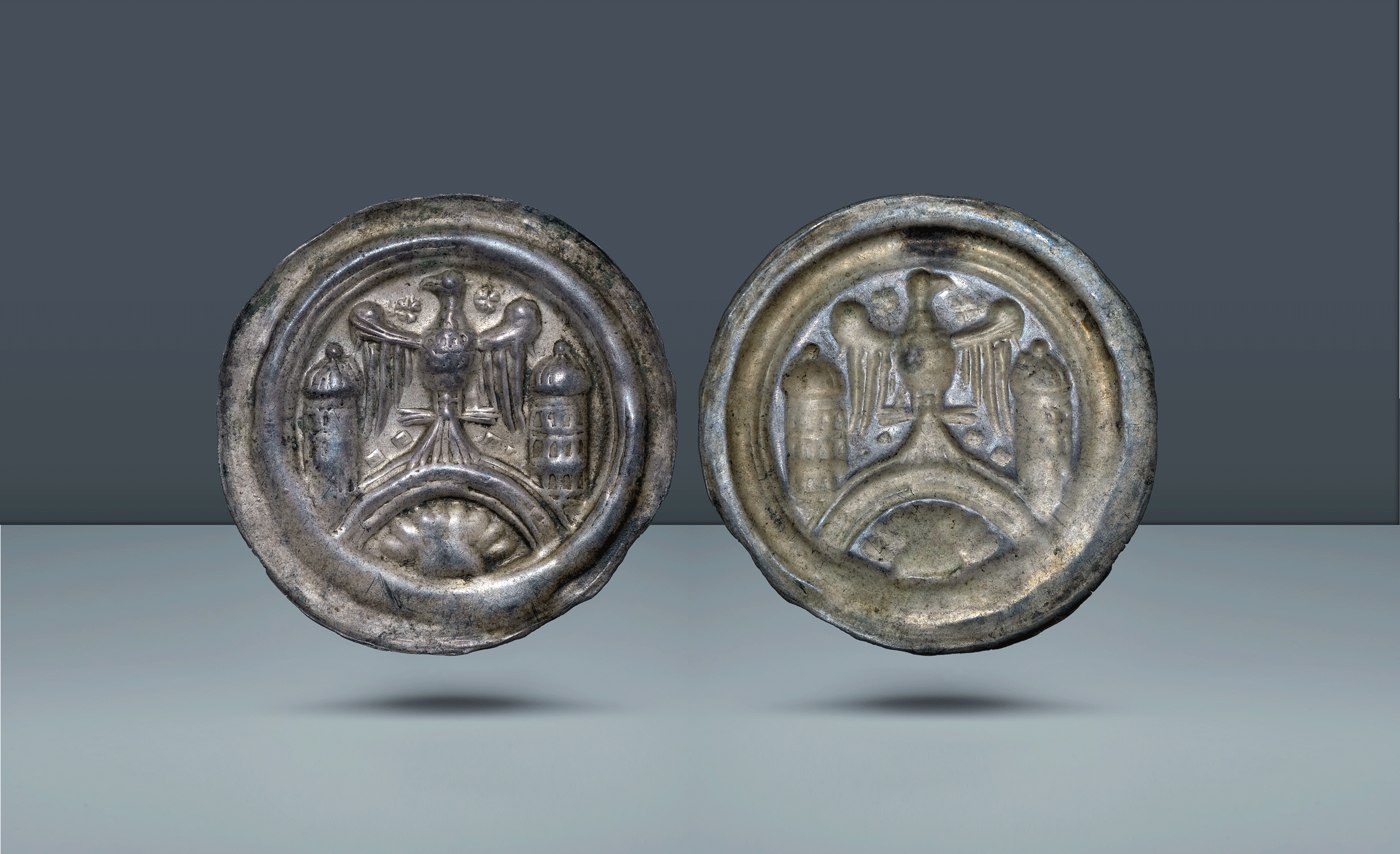
German States, Arnstein. Walter II, Hettstedt, c. 1135-1176 AD
AR Brakteate, 0.75g (29.2mm, n/a).
Eagle facing forward with outstretched wings, head turned to the left, positioned between two towers resting on an arch containing a palmette.
Pedigree: Ex. Leipziger Münzhandlung and Heidrun Höhn 94, Leipzig 2020, Lot 1146.
References: Berger 1476; Slg. Bonhoff 568; Slg. Löbbecke 219.
Grade: Nicely toned and with nice imagery. EF for type
wc1353
Scroll down for more information about this coin.
The silver bracteate constitutes a distinctive uniface coinage that emerged circa 1130 in Saxony and Thuringia and subsequently became the predominant regional denomination throughout most German-speaking territories, excluding the Rhineland and Westphalia, until well into the fourteenth century. Struck from silver sheet of exceptional thinness - these pfennigs are frequently cited as among the thinnest coins in monetary history - bracteates represent a significant technical departure from conventional two-die hammered coinage. The requisite metallurgical expertise appears to have derived from goldsmithing workshops rather than from established minting practice.
The production sequence began with the reduction of silver to a foil considerably thinner than an ordinary flan, from which blanks were prepared; the evidence suggests that flans were generally trimmed to shape after striking, although pre-cut blanks are also attested. Striking employed a single engraved die in conjunction with a yielding substrate, typically lead or leather, placed beneath the flan. Critically, the die was engraved to a depth exceeding the total thickness of the blank itself. Under the force of the hammer blow, the metal deformed fully into the die cavity, producing an obverse in high relief and a reverse bearing the incuse, mirror-reversed impression of the same design - the defining morphological characteristic of the type.
The technique conferred considerable economies of production. The engraving of only a single die reduced both cost and preparation time, while multiple stacked flans could be struck simultaneously upon the leather backing. Furthermore, die longevity substantially exceeded that of dies employed for two-faced coinage, as the compliant substrate cushioned the blow and the attenuated flan required markedly less striking force. These efficiencies proved well suited to the political fragmentation of Central Europe and to the fiscal practice of periodic re-coinage (renovatio monetae), conditions under which more than ten thousand distinct bracteate types were ultimately produced.