
Germany, Landau. 1702
Germany, Landau. 1702
AR Medal, (43mm, 11h)
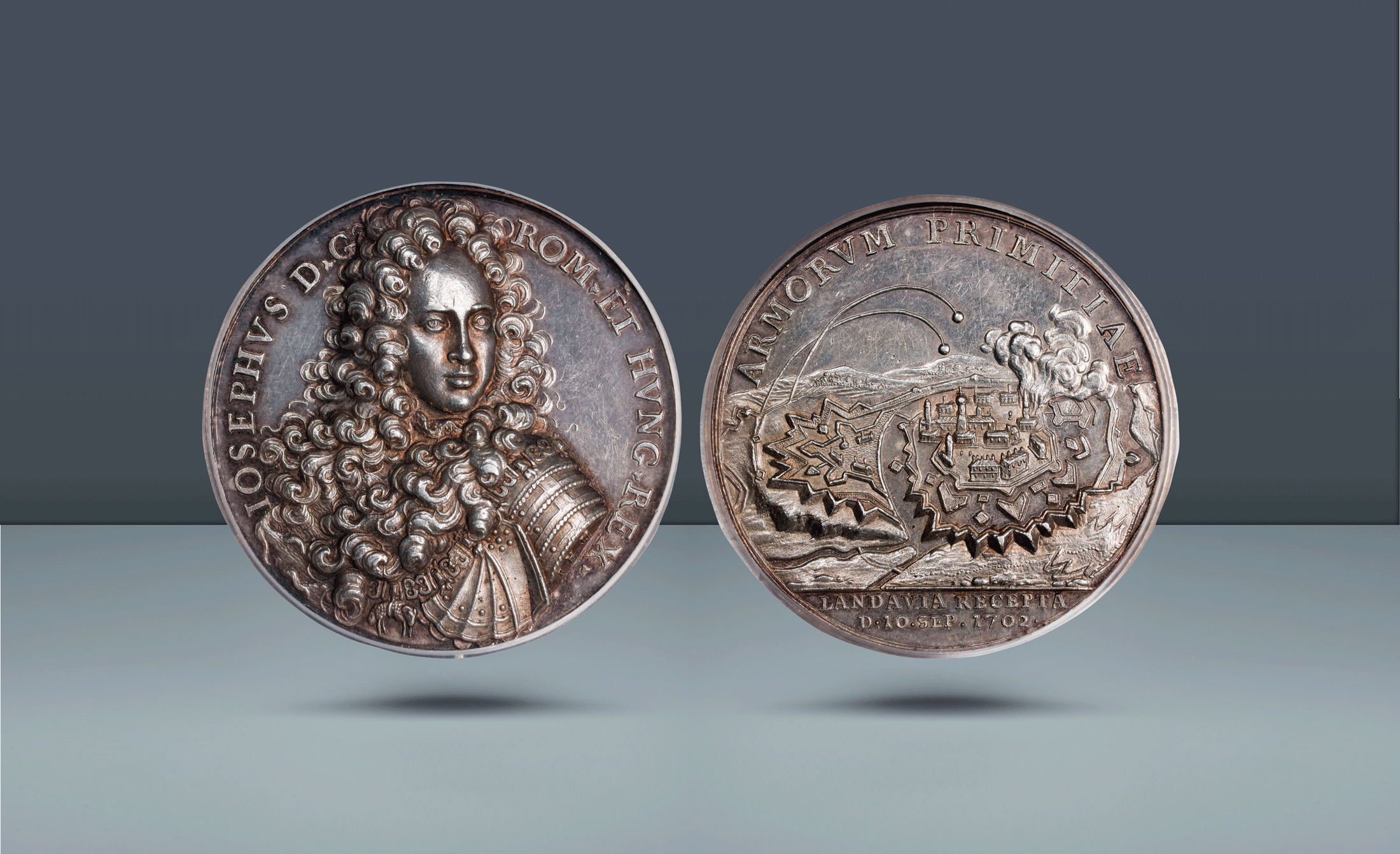
Siege of Landau - Armored forward facing bust of Holy Roman Emperor Joseph I / The city of Landau with star fort defenses being besieged with part of it ablaze.
References: Mont 1286. Forster 711
Grade: PCGS Graded MS62
wc1380
Scroll down for more information about this coin.
Located in the Palatinate, Landau had been under French control since the 17th century. Between 1688 and 1691, Sébastien Le Prestre de Vauban rebuilt it as a modern fortress, making it one of the key strongpoints guarding France's Rhine frontier. As such, it became a central objective of the War of the Spanish Succession (1701–1714). Landau was besieged four times during the conflict, changing hands with each siege. The first and best-known siege, which is depicted on this medal, began in 1702.
In the spring of 1702, Louis William, Margrave of Baden-Baden, crossed the Rhine near Speyer at the head of an army drawn from the Imperial Circles and the Electoral Palatinate. By June, his force numbered roughly 46,000 men. Landau, by contrast, was held by the 72-year-old Comte de Mélac with just over 4,300 soldiers. The siege began on 16 June. However, the Imperial army initially had no heavy artillery. A siege train was eventually assembled from guns supplied by the imperial cities of Augsburg, Frankfurt, Nuremberg, and Ulm, and the bombardment began on 2 July. On 26 July, Archduke Joseph, the future emperor, arrived with 250 courtiers and took nominal command, although Louis of Baden continued to make the key decisions. Upon realizing this, Mélac reportedly asked where Joseph's headquarters were so that he could bombard them; On the night of 6 August, a mine breached the counterscarp, and Imperial troops gained a foothold in the. By late August, the garrison's situation had become desperate. Running short of ammunition, the defenders stripped the lead from the town's windows to cast bullets.
Mélac's council of war resolved to surrender on 9 September, and the capitulation was signed the following day.