
Germany, Second Empire. Karl Goetz, Munich, c. 1905
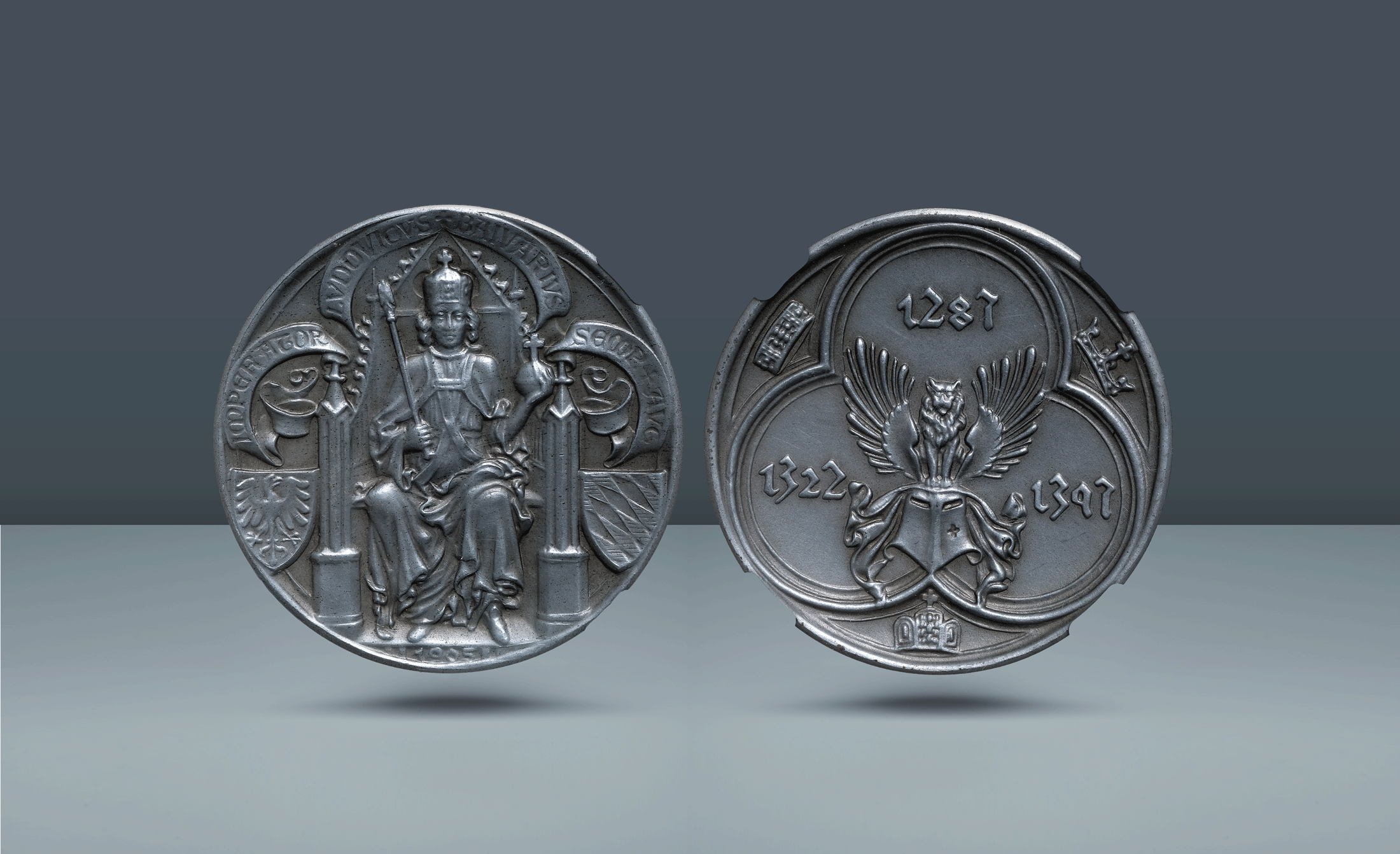
Germany, Second Empire. Karl Goetz, Munich, c. 1905
ZN medal, slabbed (36mm, 12h).
Crowned and draped figure of Ludwig seated facing on throne, holding scepter and orb; all within Gothic portico / Crested helmet facing within trilobe, with crowns in spandrels. Edge: BAYER. HAUPTMÜNZ
References: Kienast 1
Grade: NGC graded MS 62
wc1312c
Scroll down for more information about this coin.
Karl Goetz stands as one of the most prolific and technically accomplished medalists of early twentieth-century Germany, a career that would eventually make him notorious for his sharply satirical and propagandistic medallic commentary during the First World War, but which began, as this piece attests, in the more traditional idiom of commemorative and artistic medal-making in Munich. Struck around 1905 and catalogued as Kienast 1, this zinc medal represents one of the earliest entries in Goetz's documented body of work, produced at a moment when he was establishing himself within Munich's rich tradition of medallic art, a milieu shaped by the city's status as a center of both fine art training and official Bavarian minting.
The obverse presents the crowned and draped figure of Ludwig enthroned in a frontal, hieratic pose, scepter in one hand and orb in the other, the whole composition framed within a Gothic portico that lends the design an air of ecclesiastical solemnity and dynastic permanence. This architectural framing device, drawing on the pointed arches and vertical emphasis of Gothic tracery, situates the seated monarch within a visual language more commonly associated with cathedral portal sculpture or stained glass than with conventional medallic portraiture, a choice that speaks to Goetz's early interest in historicist and revivalist ornament. The reverse turns to a more martial register, a crested helmet shown facing within a trilobed frame, crowns filling the spandrels at each corner, a heraldic composition that reinforces themes of royal and princely authority through the accoutrements of rule rather than a portrait bust. The edge inscription, BAYER. HAUPTMÜNZ, identifies the Bavarian Main Mint in Munich as the striking authority, confirming the medal's official production context within the Wittelsbach kingdom's minting apparatus during the Second Empire period, when Bavaria retained its own royal house and mint even as a constituent state of unified Germany.
As Kienast 1, the medal holds a foundational place in the reference literature on Goetz's oeuvre, marking the starting point of a catalogue that would go on to encompass hundreds of medals across a career of extraordinary range and, in later years, considerable controversy. Graded NGC MS 62, the piece survives in choice condition, its details crisp and its surfaces well preserved.