
Gaul, Veneti. Armorica, c. 3rd century BC
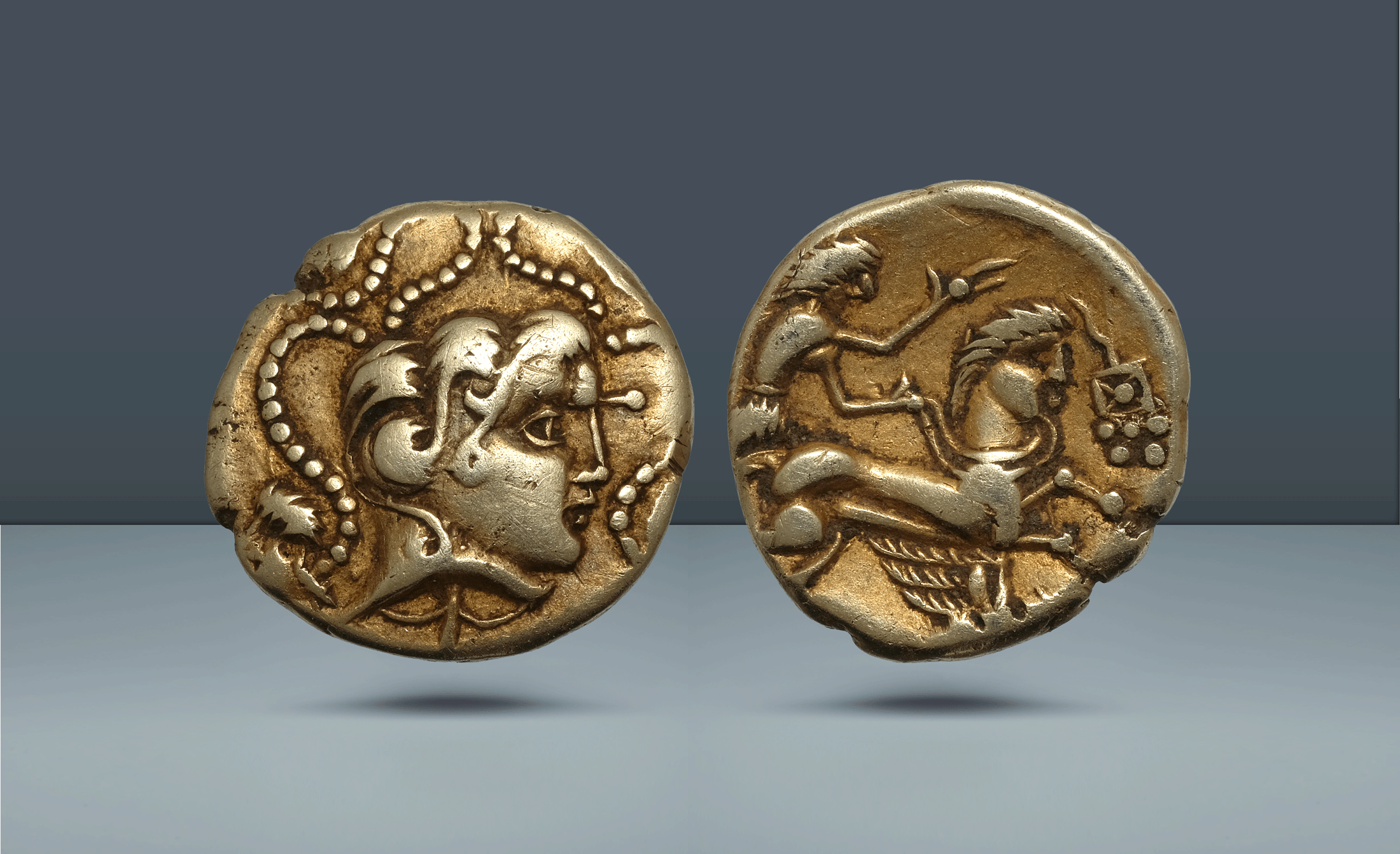
Gaul, Veneti. Armorica, c. 3rd century BC
AV Quarter Stater, 1.91g (12.3mm, 9h).
"à la petite tête nue" type. Head facing to r.; three strands of pearls semi-circularly surround the head / Anthropomorphic-headed horse with charioteer facing to r.; beneath, a recumbent winged figure to r.
References: de la Tour, Atlas De Monnaies Gauloises Préparé Par La Commission De Topographie Des Gaules, 6838; Delestree and Tache, Nouvel Atlas Des Monnaies Gauloises. Part II: From Série 284, DT 2126 - DT 2129
Grade: In unusually fine condition for a gold Celtic coin. Nicely struck with lovely details. Mint State for issue
gk2148
Scroll down for more information about this coin.
The Veneti were a southern Armorican Gallic tribe that occupied the Morbihan coast in western France. The principal sources on the tribe are Julius Caesar, Cassius Dio. Unfortunately the only way we can hear from the Veneti personally is the archaeology taken from promontory forts, coastal settlements, and salt-working sites.
Caesar describes them as the most powerful Armorican peoples, whose authority rested on sea power. In fact, they possessed the largest celtic fleet. Through which they controlled the harbors along the Atlantic seaboard, and levied tolls on cross-Channel traffic toward Britain, with which they traded regularly. Their vessels, high-prowed, flat-bottomed, oak-built, with leather sails and iron anchor chains, were engineered for Atlantic conditions and impressed Caesar sufficiently to warrant an extended excursus.
In the winter of 57/56 BC the Veneti detained Roman requisitioning officers and led a coalition of Armorican states in revolt, calculating that their coastal strongholds and naval superiority made them invulnerable. Caesar responded by building a fleet on the Loire under Decimus Brutus. After a summer of frustrating sieges, the war was decided in a single engagement off the Morbihan coast (56 BC), where Roman crews used hooked poles to cut the Venetic halyards. Becalmed, the fleet was destroyed piecemeal. Caesar's reprisal was exemplary: the Veneti leadership was executed and the population sold into slavery. Under Roman rule the Veneti persisted as a modest administrative unit of Gallia Lugdunensis centered on Darioritum.