
Islands off Attica, Aegina. c. 404-350
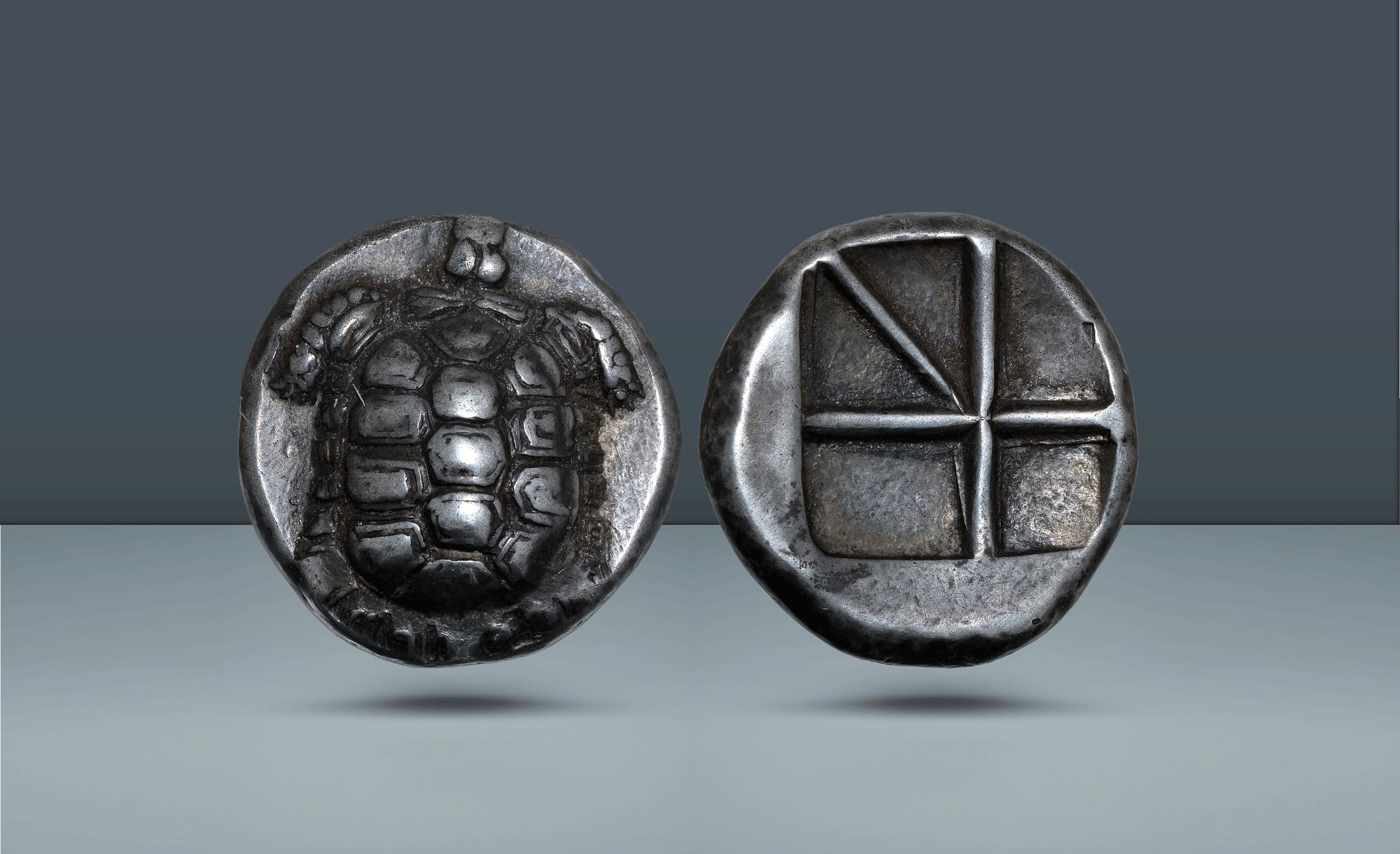
Islands off Attica, Aegina. c. 404-350
AR Stater, 12.18g (21mm, ).
Land tortoise / Quadripartite incuse square with one square divided
Pedigree: Ex Thierry Parsy, 23 March 2016, lot 30. Ex Gorny & Mosch 249, 2017, lot 250. From the Comte René Philipon (1870-1936) collection.
References: Milbank, Period V, b and pl. II, 14-15. SNG Lockett 1751. HGC 6, 438.
Grade: Struck in high relief and with a wonderful old cabinet tone. EF
gk2123
Scroll down for more information about this coin.
Aegina has a strong claim to being the birthplace of Greek coinage in the European sense. The island's silver staters, struck from at least the mid-seventh century BC, were among the earliest coins to circulate widely across the Aegean world, and the Aeginetan weight standard they established became the dominant commercial measure across much of Greece for generations. Before Athens rose to naval supremacy and imposed its own owls on Mediterranean trade, it was the turtle of Aegina that merchants from the Black Sea to Sicily knew and trusted.
The tortoise itself is one of the most immediately recognizable devices in all of ancient numismatics. Early Aeginetan staters carried a sea turtle, reflecting the island's maritime identity. Sometime around the early fifth century the type shifted to the land tortoise shown here - a change scholars have debated but never definitively explained, possibly reflecting a deliberate rebranding after Aegina's crushing defeat by Athens in 457 BC and the expulsion of its population. The incuse reverse - a square punched into the blank by the lower die, subdivided into quadrants with one further divided - is equally ancient in concept, a utilitarian feature of early coining technique that Aegina retained long after other mints had moved to figured reverses, transforming a technical necessity into a recognizable trademark.
This stater belongs to Period V in Milbank's classification, placing it in the post-war phase of Aeginetan coinage after 404 BC, when the island recovered some autonomy following Sparta's defeat of Athens. The coins of this period are struck with a confidence and relief that reflects the mint's renewed activity. The tortoise here is rendered with exceptional plasticity - the shell articulated in careful detail, the head and limbs projecting with a sculptural presence that photographs rarely do justice to.
The provenance is one of the finest aspects of this piece. The collection of Comte René Philipon (1870–1936) represents one of the great early twentieth-century French accumulations of ancient coins, assembled in an era when the finest material from old European cabinets was still accessible to private collectors of means and discernment. Coins traceable to collections of that generation carry an implicit guarantee of long, stable custody - and the subsequent auction appearances at Parsy in 2016 and Gorny & Mosch in 2017 provide a fully documented modern chain of ownership.
The cabinet tone is exceptional: a deep, warm patina of the kind that only develops over a century or more of undisturbed storage. Combined with the high-relief strike and the coin's overall preservation, this is the sort of Aeginetan stater that comes to market rarely and that collectors of archaic Greek silver wait years to encounter.