Kingdom of Macedon, Colophon or Magnesia ad Meandrum. Philip II (Posthumous), 359 – 336 BC, c. 322 BC
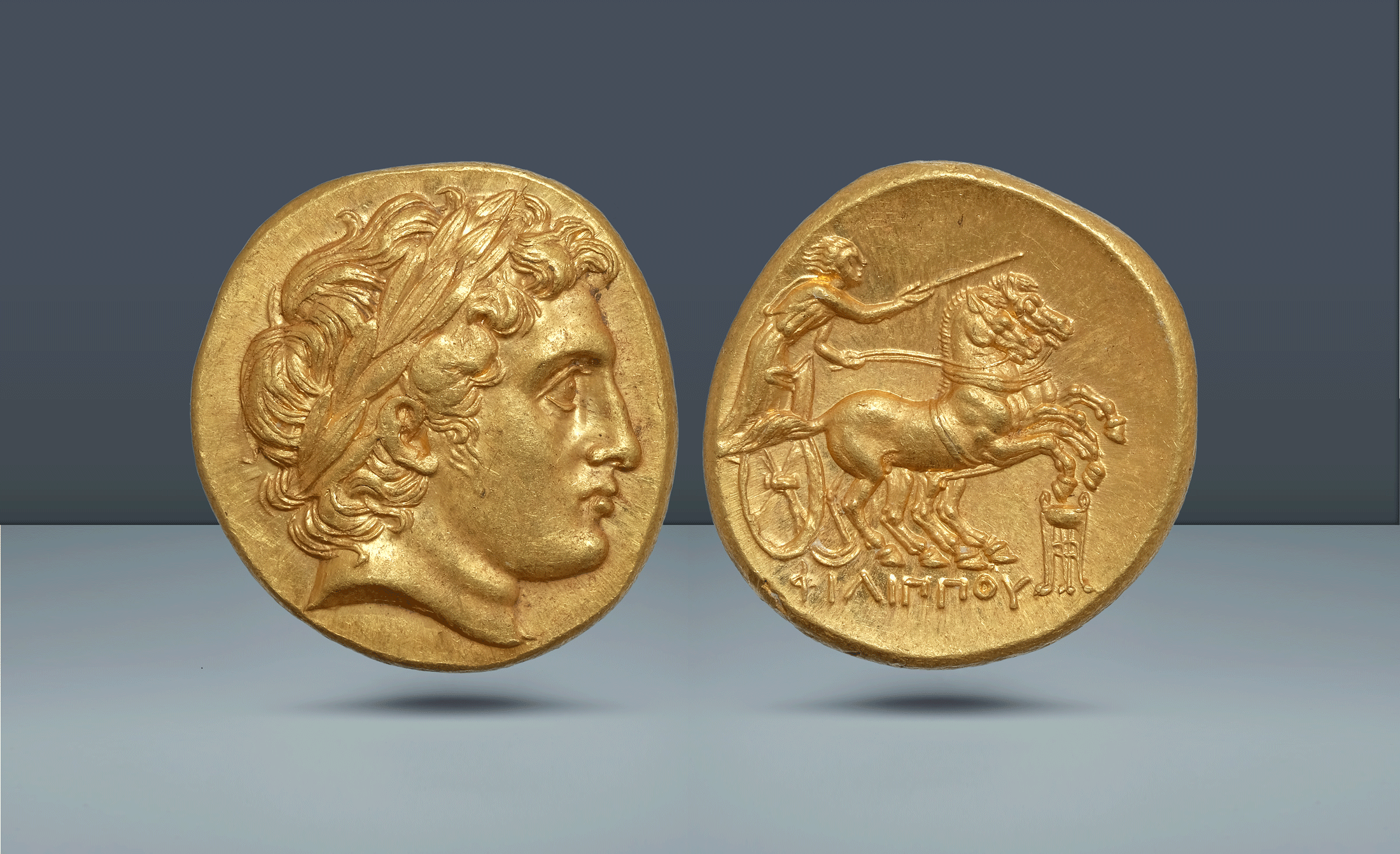
Kingdom of Macedon, Colophon or Magnesia ad Meandrum. Philip II (Posthumous), 359 – 336 BC, c. 322 BC
AV Stater, 8.6g (19mm, 11h).
Laureate head of Apollo r. / ΦΙΛΙΠΠΟΥ Prancing biga r., driven by charioteer holding kentron and reins; below horses, tripod
Pedigree: Privately purchased from Spink & Sons.
References: Thompson, Posthumous Philip II staters of Asia Minor, in Studia Oblata 12. Jameson 978 = Gillet 785 (this obverse die). Le Rider pl. 90, 16 and pl. 93, 26.
Grade: A well struck and lustrous gold stater. Some minor marks, otherwise Mint State
gk2062
Scroll down for more information about this coin.
Based solely on the reverse design, this type of coin is occasionally called Philip II’s “victory series”. Why? Because Philip won three major Olympic races: the 356 BC Keles or Horse Race, the 352 BC Tethrippon or Four-Horse Chariot Race and the 348 BC Synoris or two-horse Chariot Race. The most applicable in this case would be the last when Philip won the Synoris during the 108th Olympic games in 348 BC.
While Philip's 348 BC victory was less prominently featured on his coinage than his earlier victories, it contributed to the overall program of equestrian imagery on his coins. These coins typically showed either a single horseman or a two-horse chariot or biga.
The Synoris victory thus reinforced Philip's threefold message through coins: that he was a legitimate Greek (only Greeks could compete at Olympia), that he enjoyed divine favor (Olympic victors were believed chosen by the gods), and that he possessed the wealth and prestige befitting a great king. By 348 BC, Philip had established an unmatched Olympic record among contemporary rulers, cementing his Pan-Hellenic credentials just as he was preparing his political and military domination of Greece.
While the reverse is impressive, it is the obverse that elevates this stater to one of the most desirable-and highest-hammering-types of Philip II. Its distinctive portrait style, unlike any other die in the series, has led many to suggest that it represents none other than Philip’s son, Alexander III the Great.