Kings of Macedon, Macedon. Alexander III, 'the Great' , 336-323 BC Amphipolis, c. 323-320 BC
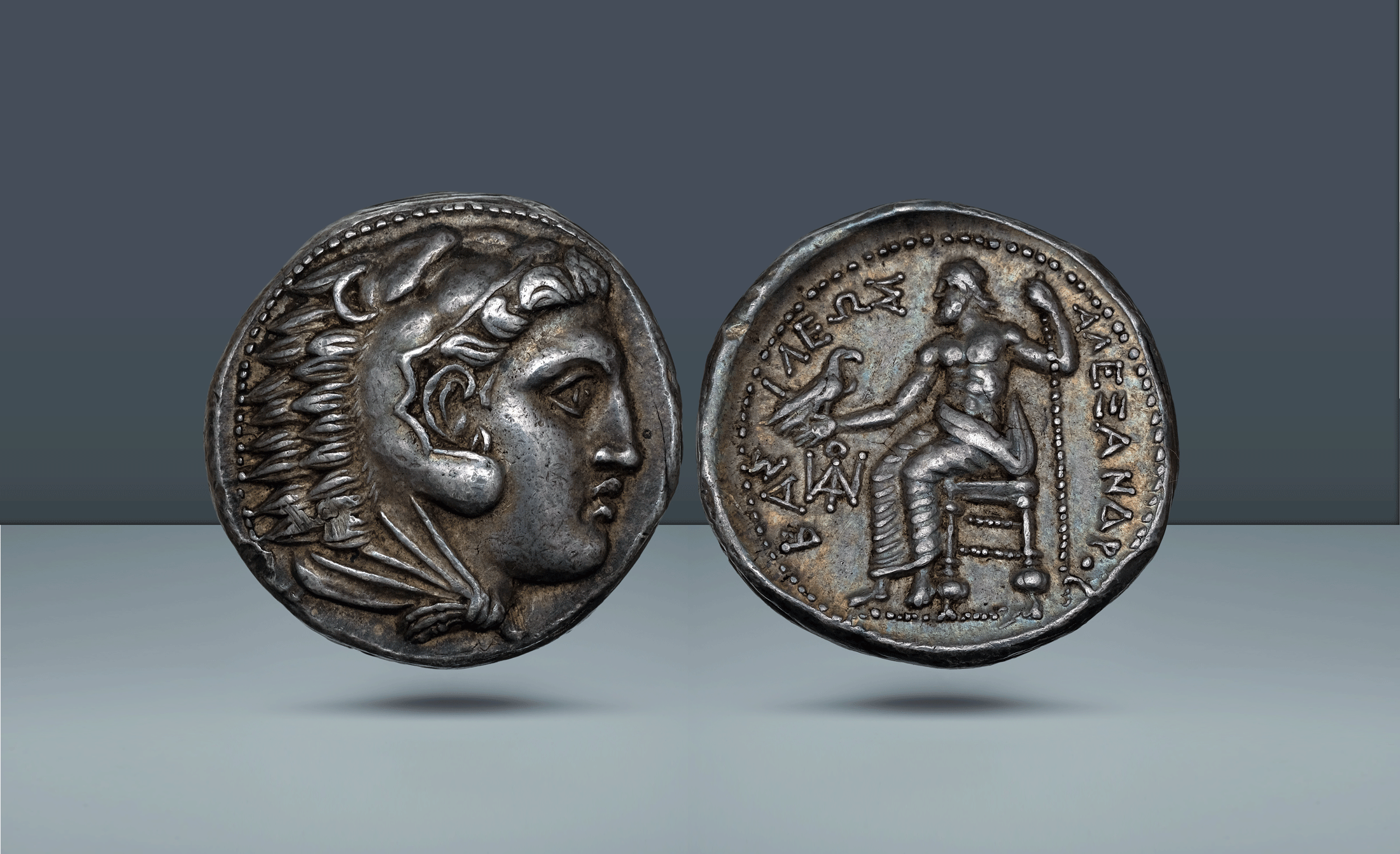
Kings of Macedon, Macedon. Alexander III, 'the Great' , 336-323 BC Amphipolis, c. 323-320 BC
AR Tetradrachm, 17.29g (16mm, 7h).
Head of unbearded Heracles r., wearing lion skin. / BAΣIΛEΩΣ - AΛEΞANΔPOY Zeus, wearing himation, nude to waist, seated l. on diphros, holding sceptre with his l. hand, eagle on his outstretched r. hand; monogram in l. field.
Pedigree: From an old Swiss collection started in the 19th century
References: Price 101, 120; Meydancikkale 30, 77; SNG Oxford 2606.
Grade: Beautiful Macedonian lifetime example with toned surfaces and sharp strike. Mint State
gk2180
Scroll down for more information about this coin.
Martin Jessop Price was Keeper of Coins and Medals at the British Museum, and his two-volume catalogue, text in one and plates in the other, published jointly by British Museum Press and the Swiss Numismatic Society, replaced a reference that had stood since 1855. While Ludvig Müller's Numismatique d'Alexandre le Grand had served for well over the past century, it was definitely obsolete.
Price built outward from the BM holdings into other collections and, crucially, into hoard evidence, so the result functions as a corpus of the entire coinage rather than an inventory of one cabinet. It covers gold, silver, and bronze issued in the names of Alexander III and Philip III Arrhidaeus, arranged geographically by mint from Macedonia eastward through Thrace, Asia Minor, Cyprus, Phoenicia, Egypt, Babylonia, and Iran. Containing roughly four thousand catalogue entries, Price number is now simply how these coins are cited. Auction descriptions, museum records, and scholarly articles all use it. Whatever the book's defects, that standardisation was worth the effort on its own. Before it, referencing an Alexanderine coin meant navigating Müller's obsolete framework or describing the coin from scratch.