
Thrace, Lysimacheia. Lysimachus, 323-281 BC, c. 297-282 BC
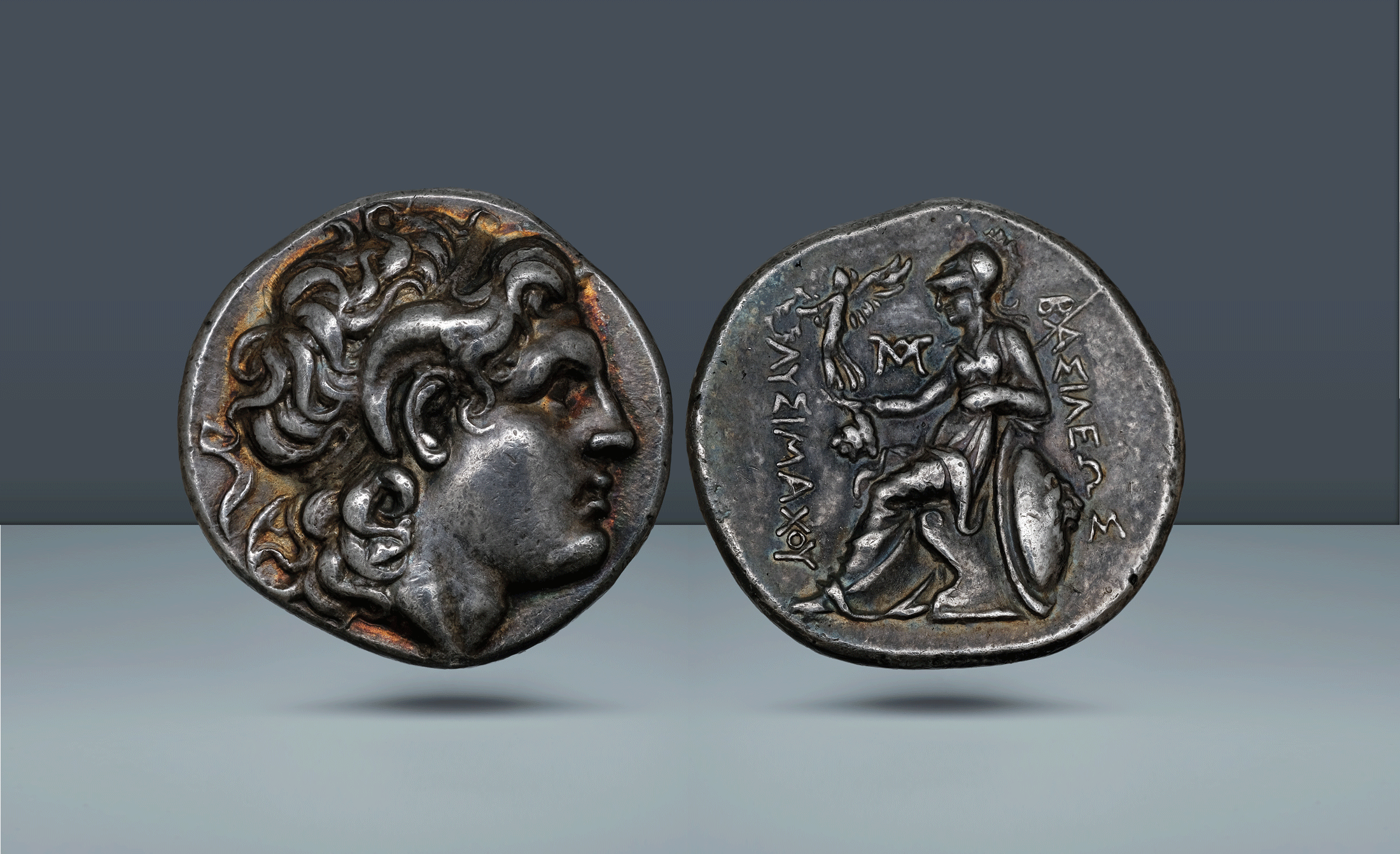
Thrace, Lysimacheia. Lysimachus, 323-281 BC, c. 297-282 BC
AR Tetradrachm, 16.57g (26mm, 12h).
Head r. of deified Alexander the Great, wearing royal diadem and ram's horn. / BAΣIΛEΩΣ - ΛYΣIMAXOY Athena, wearing long chiton, peplos and crested Corinthian helmet, seated l. on throne, her l. arm resting on large shield decorated with lion head, lance leaning against her l. shoulder; on her outstretched r. hand, Nike crowning the royal name; in field l., monogram and lion head
Pedigree: From an old Swiss collection started in the 19th century
References: Thompson, Lysimachus 169, 11 var. (lion head in exergue).
Grade: Fantastic high relief with cabinet toning and iridescence. Mint State
gk2178
Scroll down for more information about this coin.
Born at Pella to Agathokles, a Thessalian from Krannon who had risen as a companion of Philip II. Lysimachus became one of Alexander's seven somatophylakes, the innermost bodyguard, and went the whole distance to India. The story that Alexander punished him by shutting him in with a lion is late and almost certainly invented.
The Babylon settlement of 323 gave him Thrace, the least attractive assignment on the table. He spent a decade fighting Seuthes III and the Odrysians and never held the interior securely. From 315 he joined Ptolemy, Kassander, and Seleukos against Antigonos Monophthalmos. In 309/8 he founded Lysimacheia on the Chersonese as his capital. In 306/5 he took the royal title alongside the other Diadochoi. His victory a few years later at the battle of Ipsos in 301, made him. Allied with Seleukos, he broke Antigonos, who died on the field, and took most of Asia Minor west of the Taurus. Wealth followed, including the nine thousand talents he deposited at Pergamon under Philetairos, a decision that eventually produced the Attalid dynasty.
Between 288 and 285 he stripped Demetrios Poliorketes of Macedonia in concert with Pyrrhus, then pushed Pyrrhus out as well. At roughly seventy-five he ruled Thrace, western Asia Minor, Macedonia, and Thessaly. However, it all came apart over the issue of succession. In 283/2, at his wife's urging, he had Agathokles executed. The court fractured; Agathokles's widow Lysandra fled to Seleukos with enough grievance to justify a war. At Corupedium in Lydia in 281, Seleukos defeated and killed him.