
Roman Republic, Italy. Faustus Cornelius Sulla. Rome, c. 56 BC
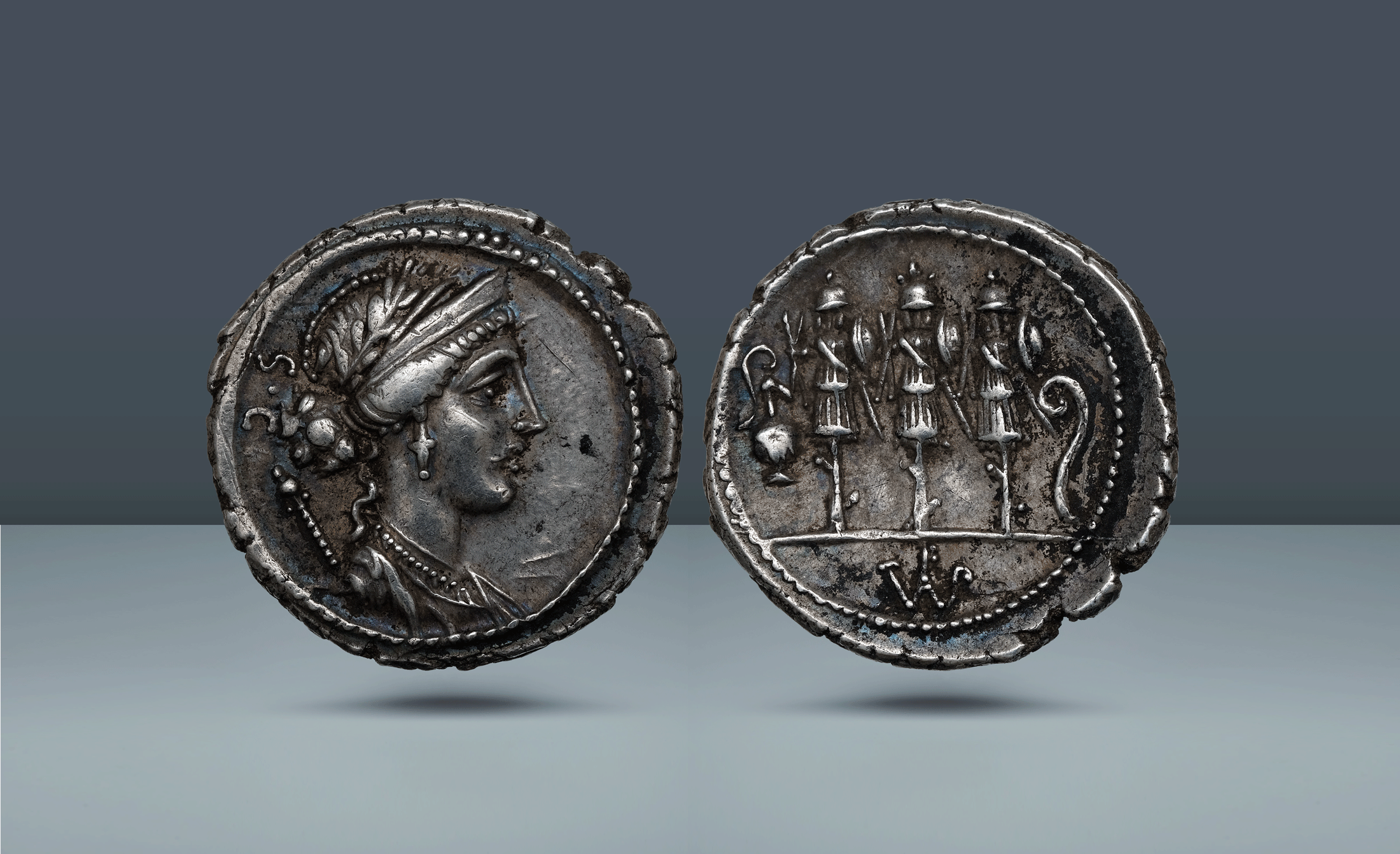
Roman Republic, Italy. Faustus Cornelius Sulla. Rome, c. 56 BC
AR Denarius, 3.94g (19mm, 5h)
S•C Laureate, diademed and draped bust of Venus to r.; behind, scepter / Three military trophies; jug to l. and lituus to r.; monogram of Faustus in exergue.
Pedigree: Ex Hirsch 244, 2006, lot 1677. Ex Hirsch 240, 2005, lot (p. 161)
References: Craw 426/3; Syd 884; Cornelia 63; RBW 1528.
Grade: A few isolated marks in the fields. Lovely strike with cabinet toning. EF
rr1416
Traditionally, after a military victory, Greek armies would set up a tropaion at the spot where the enemy had turned and fled. This usually consisted of a post or tree trunk hung with captured helmets, armour, shields and spears. It served as both an offering to the gods and a marker of the win. The Romans adopted the practice, and the trophy soon became one of their standard images of military success.
On Republican coinage, the trophy first became common on the victoriatus, introduced during the Second Punic War, which depicts Victory crowning a trophy. The design later moved to the quinarius and was struck for decades. At this stage, the trophy represented the victories of Rome as a whole.
However, this changed in the first century BC, as ambitious generals began using coinage to promote themselves. In 84–83 BCE, Sulla issued coins showing two trophies between a jug and a lituus, the augur's curved staff, with the legend IMPER ITERVM. The trophies are generally understood to reference his victories over the armies of Mithradates at Chaeronea and Orchomenus, while the priestly implements signalled divine approval.
This particular denarius, struck in 56 BC by Sulla's son Faustus, copies his father's design but adds a third trophy. These almost certainly represent the three triumphs of Faustus's father-in-law, Pompey, over Africa, Spain and the East, with the jug and lituus now referring to Pompey's role as an augur.