
Roman Republic, Italy. Q. Pompeius Rufus, Rome, c. 54 BC
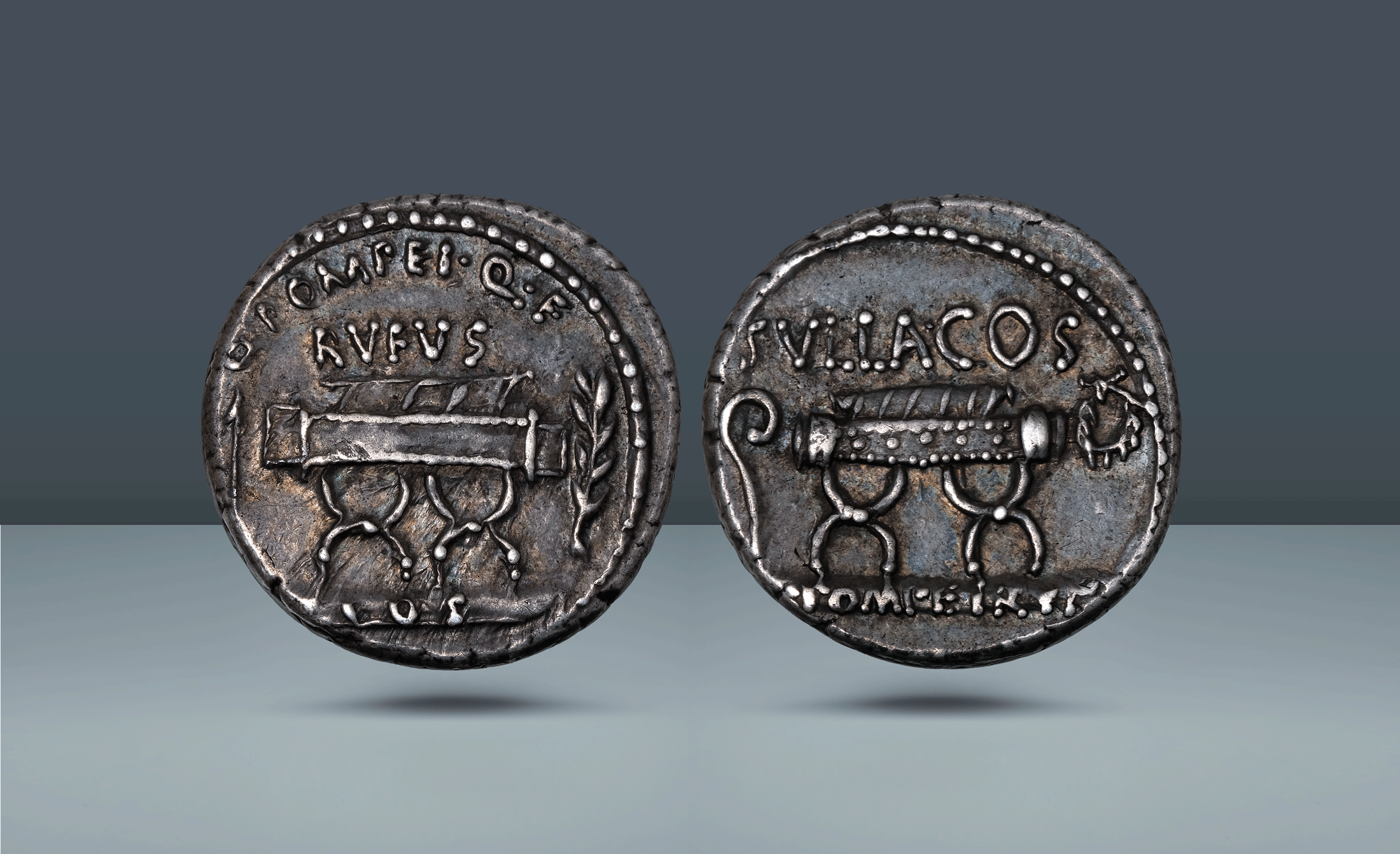
Roman Republic, Italy. Q. Pompeius Rufus, Rome, c. 54 BC
AR Denarius, 4.17g (18mm, 9h).
Q POMPEI Q F - RVFVS, curule chair, arrow to l., laurel-branch to r., tablet inscribed COS below / SVLLA COS, curule chair, lituus to l., wreath to r., Q POMPEI RVF on tablet below
Pedigree: Acquired from Kunst und Münzen AG Lugano 1969.
References: Cr. 434/2. RRSC D226.2
Grade: Nicely struck with old cabinet toning. Toned EF
rr1408
Scroll down for more information about this coin.
Struck in 54 BC, this denarius is a study in dynastic self-fashioning, pairing two empty curule chairs to honor the moneyer's grandfathers on both sides of his family. Q. Pompeius Rufus was the son of a marriage between the Pompeii Rufi and the Cornelii, making him grandson of two men who had shared the consulship of 88 BC as colleagues and, briefly, as rivals: Q. Pompeius Rufus on his father's side, and L. Cornelius Sulla on his mother's. The type sets their offices side by side without portraiture, relying instead on emblems of priestly and magisterial rank to distinguish one grandfather from the other. The obverse chair, flanked by an arrow and a laurel-branch - both attributes of Apollo - alludes to the moneyer's own probable membership in the college of the Xviri sacris faciundis, the board charged with guarding the Sibylline Books and overseeing the Apollonian rites, and by extension gestures toward his paternal line. The reverse chair, flanked by a lituus and a wreath, signals Sulla's augurate, the wreath here read as priestly rather than purely honorific - Crawford compares its use on nos. 418 and 419 as a mark of augural office, against Alföldi's doubts on the point.
The pairing was not idle antiquarianism. Coming down in the tense years after Pompey's second consulship, when rumors of a Pompeian dictatorship were circulating freely in Cicero's correspondence, the type's insistence on the moneyer's descent from two Cos. 88 colleagues reads as a quiet assertion of inherited constitutional legitimacy - a reminder, on the eve of renewed dynastic anxiety, that the moneyer's own claim to distinction ran through two men who had once held the Republic's highest office jointly and lawfully. Crawford notes the parallel gesture toward a maternal grandfather on no. 480/1, and the same impulse appears in the roughly contemporary inscription honoring C. Memmius as grandson of Sulla Felix.
A companion type in the same issue (Crawford 434/1) pairs portrait heads of the two grandfathers rather than their symbolic chairs, underscoring - as Zehnacker observed - how closely the engraver modeled the two likenesses on one another.