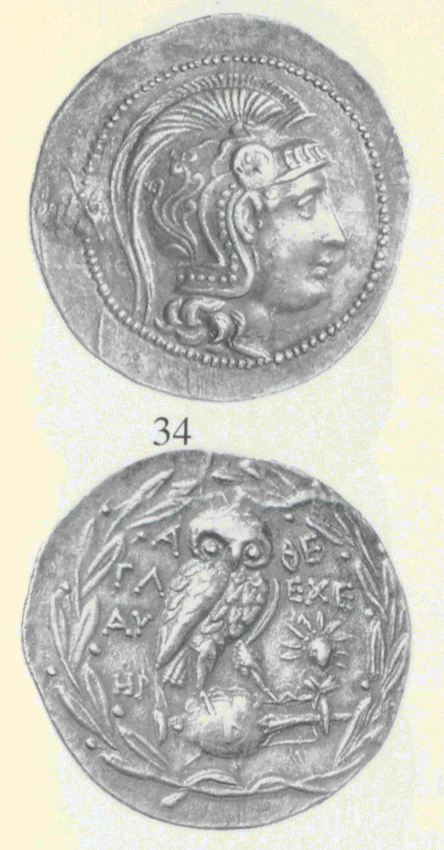
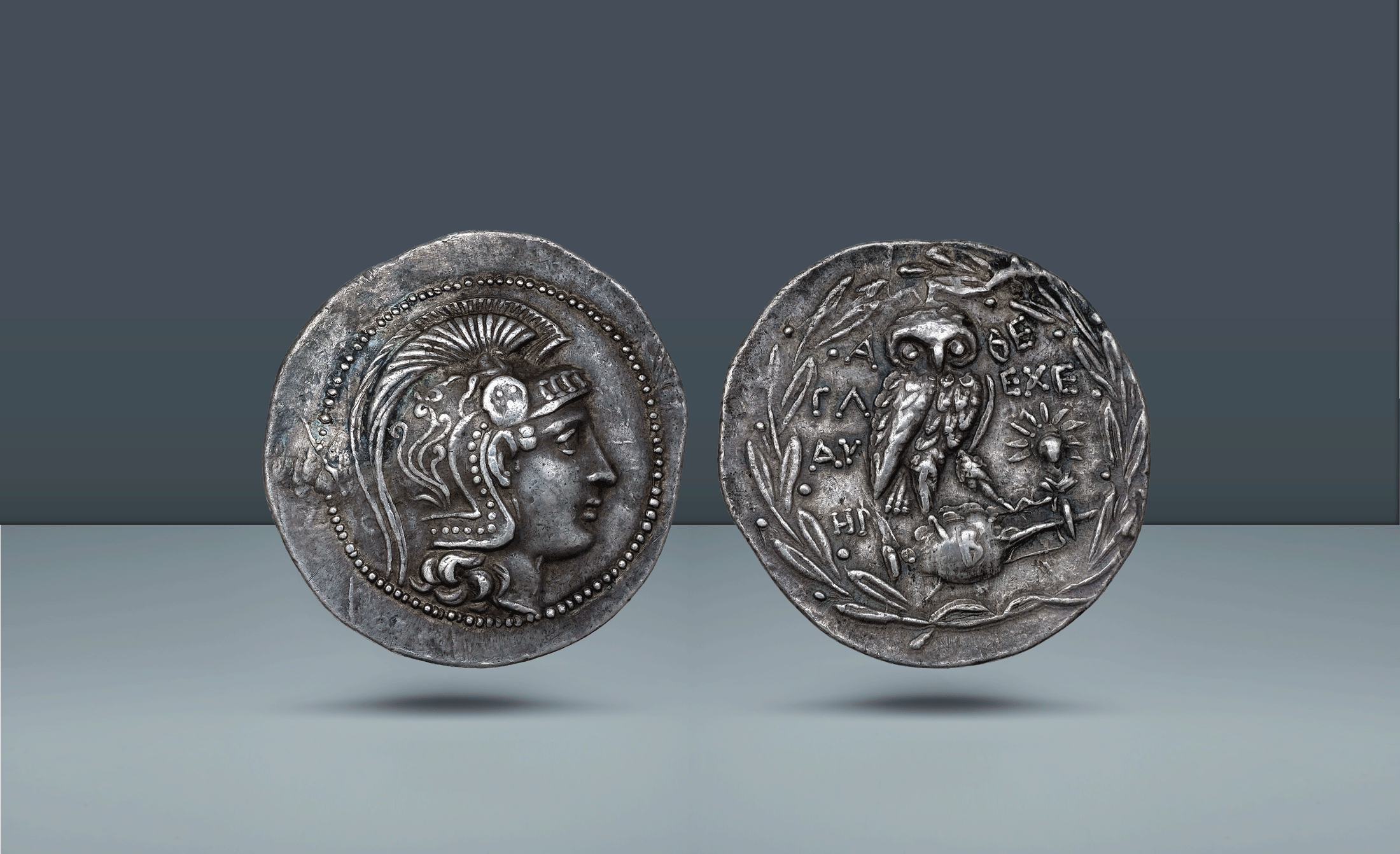
Attica, Athens. Glau... and Eche..., magistrates, 138/7 BC
, c. 165-42 BC, AR Tetradrachm, 16.71g (35.2mm, 1h).
Head of Athena Parthenos to right, wearing triple-crested Attic helmet adorned with Pegasos and long tendril on the bowl, and with the foreparts of four horses above the visor / Α-ΘΕ / ΓΛ/AY - EXE Owl standing facing on amphora; to right, radiate and draped bust of Helios facing; on amphora, B; to lower left, HP; all within laurel wreath.
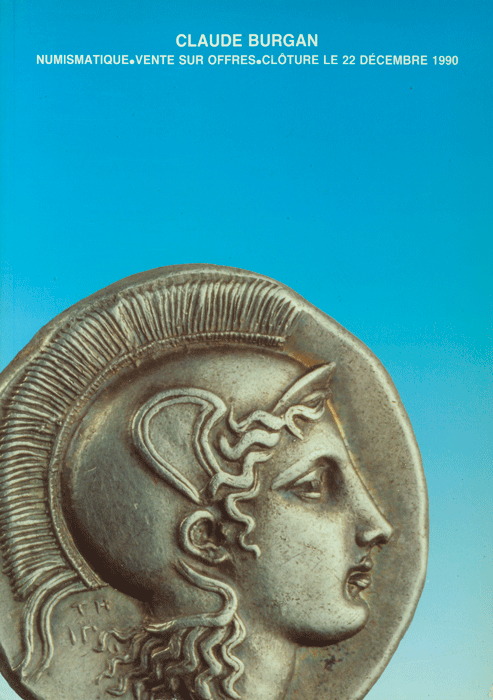
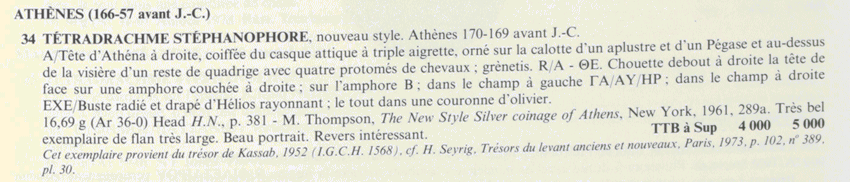
Pedigree: From the collection of J.-L. Rossignol, French amateur d'art, ex Burgan, 22 December 1990, 34 (with collector's ticket) and from the 1952 Kassab Find (IGCH 1568)
References: H. Seyrig: Trésors du Levant Ancient et Noveaux II (1973), p. 102 and pl. 37, 387 (this coin). Thompson 289a (this coin)
Grade: Lovely old cabinet toning. Official and documented hoard find from 1952. A few flan irregularities and marks. Slight doubling on the reverse. aEF
gk2161
Scroll down for more information about this coin.
In 1952 a hoard was discovered roughly 18 kilometers south of the town of Kessab, Syria. Cataloged as IGCH 1568, the find contained at least 388 tetradrachms. The count cannot be more precise because it was dispersed before anyone could study it whole. What we can piece together of the hoard reads like a who's who of the late Seleucid dynasty: Demetrius I, both reigns of Demetrius II, Antiochus VII Sidetes, the usurper Alexander II Zabinas, plus issues of Cleopatra Thea, Grypus, and Cyzicenus, whose coins date the burial to around 110 BCE. Mints range from Antioch and Damascus down to Tyre, Sidon, and Ptolemais-Ake. Interestingly there was a single Parthian tetradrachm of Phraates II from distant Susa. This might have been obtained after Antiochus VII died fighting Phraates in 129 BCE.
Mixed in were 40 Athenian New Style owls. This served as proof that Athens' silver still commanded trust in the Hellenistic East a century and a half after the city's political heyday. Those owls gave the hoard its scholarly afterlife. Since the owls can be compared to the precisely datable Seleucid issues, they became key evidence in the “famous” chronology fight between Margaret Thompson and D.M. Lewis.