
Bruttium, Kroton. c. 530-500 BC
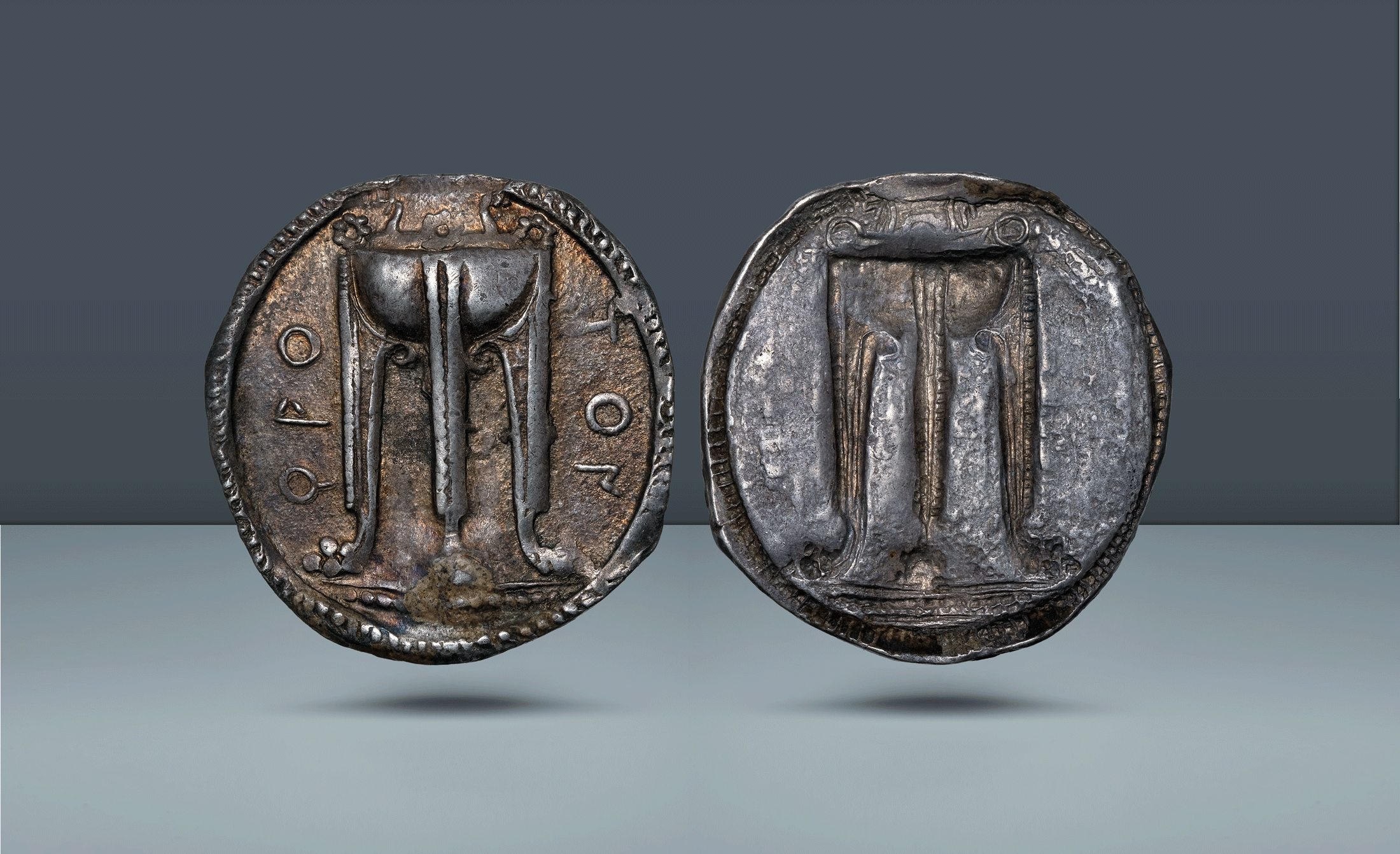
Bruttium, Kroton. c. 530-500 BC
AR Stater, 8.18g (30mm, 12h)
ϘΡΟ-TΟΝ Tripod with legs ending in lion's feet, and with three handles and snakes rising from the bowl; around, cable border. / Same type as the obverse, but incuse and without the legend; around, rayed border).
Pedigree: Reportedly acquired from Bank Leu & CO AG, Zürich, 1971.
References: Attianese 6. Gorini 5. HN Italy 2075. SNG ANS 235-6. SNG München 1422
Grade: Beautifully toned. aEF
gk2188
Scroll down for more information about this coin
Kroton was founded on the Ionian coast of southern Italy in the late eighth century BC by Achaean colonists led by Myskellos of Rhype. According to tradition, he acted on the instructions of the Delphic oracle. The city never forgot that origin. The tripod of Apollo, the prophetic seat of the Pythia, became Kroton's civic emblem and appeared on its coinage for generations. In the later sixth century Kroton was among the most powerful cities in Magna Graecia. Its athletes dominated the Olympic games, the wrestler Milo foremost among them, and its physicians were renowned throughout the Greek world. Herodotus says Democedes of Kroton was the finest of his day (3.125, 3.131). Pythagoras settled in the city around 530 BC, and in 510 BC Kroton destroyed its rival Sybaris (Herodotus 5.44).
This stater comes from the first phase of Krotoniate coinage and was struck in the incuse technique peculiar to the Achaean cities of southern Italy. The obverse type is repeated on the reverse, but sunk into the flan in mirror image, which produces thin, broad coins of great technical sophistication. The technique is sometimes linked to Pythagoras, but that is a modern suggestion and no ancient source supports it. The early date is clear from the wide 30mm flan, which later issues abandoned for thicker and more compact fabrics. The legend uses the archaic koppa, Ϙ, which dropped out of the Krotoniate ethnic in the fifth century. The tripod is rendered with care, with lion's-foot legs, three ring handles and serpents rising from the bowl, all framed by a cable border. The reverse repeats the design in incuse within a rayed border.