Gaul, Abrincatui. c. 100-50 BC
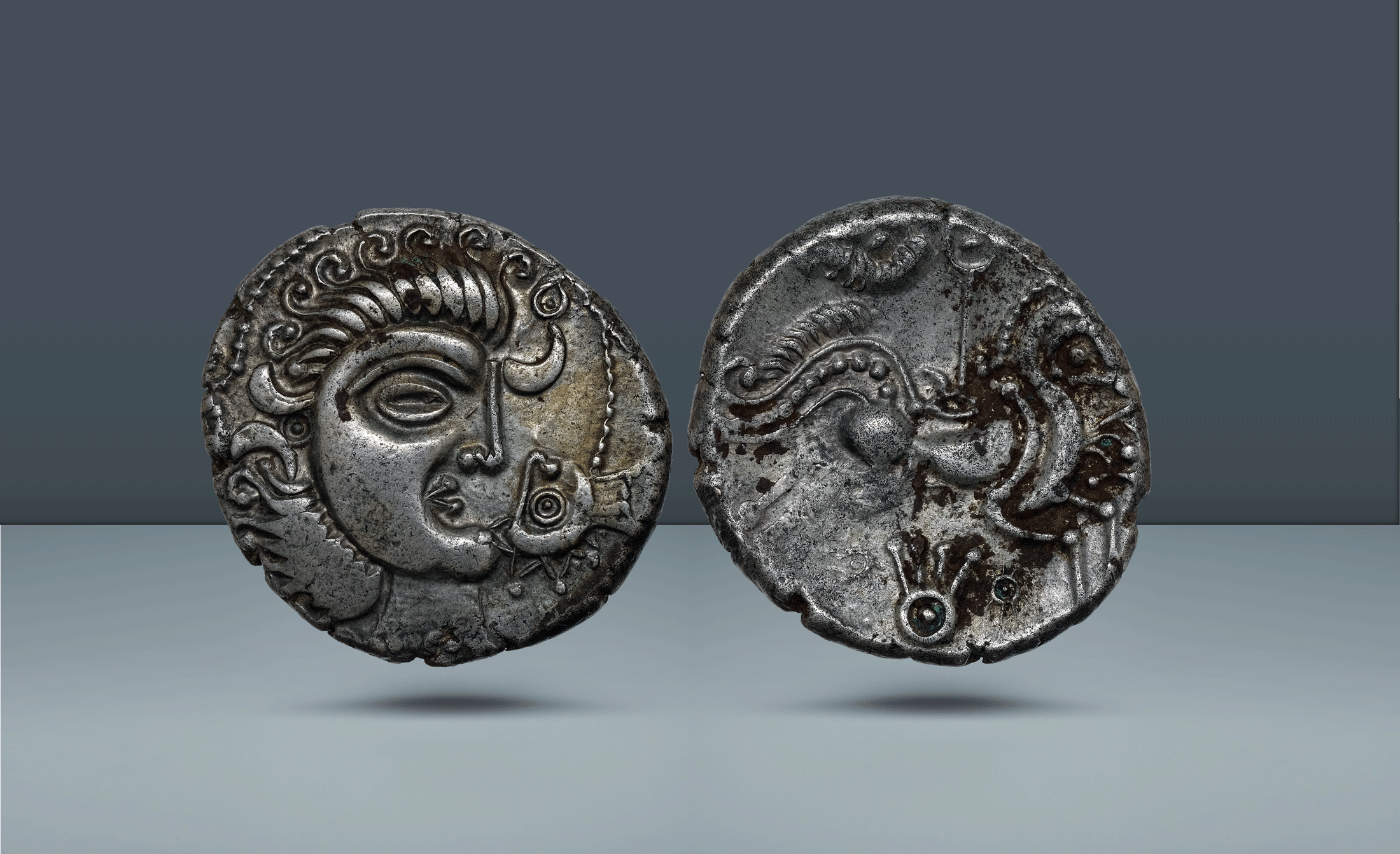
Gaul, Abrincatui. c. 100-50 BC
BI Stater, 6.61g (22mm, 9h).
Large stylized head to r. with second smaller stylized head facing upwards to r. / Stylized horse walking to r., lyre-shaped object below; "standard" on the horse's back, boar's back bristles (inverted) to l., boar-shaped "vexillum" to r.
Pedigree: Ex Marie and Heinrich Konig Collection, Saarlad Germany 1899-2002
References: DT 2281, Fleische -
Grade: Extremely interesting type with small stylized head on right side. A lovely toned example. EF
gk2196
Scroll down for more information about this coin.
The Abrincatui were a Gallic tribe settled in the region of present-day Avranches in Normandy, occupying territory along the western reaches of the Armorican peninsula in the final century before the Roman conquest of Gaul. Their coinage belongs to the broader Armorican tradition of billon staters, struck in a debased silver-copper alloy that reflects both the monetary economy of the region and the striking degree of stylistic abstraction that characterizes Gallic die engraving of the period, as Celtic craftsmen reinterpreted Hellenistic prototypes-ultimately descended from the gold staters of Philip II of Macedon-into forms increasingly divorced from their classical origins.
This example presents a striking obverse composition: a large stylized head facing right, accompanied by a second, smaller stylized head oriented upward and also facing right-a doubling device characteristic of the more inventive Armorican die engravers, who often multiplied or fragmented the Apollo-derived head motif into abstract, almost cubist arrangements. The reverse carries the equally transformed horse type, here walking right in the stiff, geometricized manner typical of the series, its body reduced to a spare linear rhythm. Below the horse is a lyre-shaped object, while above its back sits a "standard," and flanking it are two further devices drawn from the same symbolic vocabulary found across Armorican issues: boar's back bristles, here rendered inverted, to the left, and a boar-shaped "vexillum" to the right. The accumulation of these secondary symbols-standard, lyre, and boar devices-situates the type within a distinctive regional idiom in which the horse reverse becomes a field for layered emblematic ornament rather than a single unified image.
The coin carries a notable pedigree, having come from the Marie and Heinrich König Collection, formed in Saarland, Germany between 1899 and 2002-a collection history spanning over a century.