
Ionia, Miletos. c. 600-546 BC
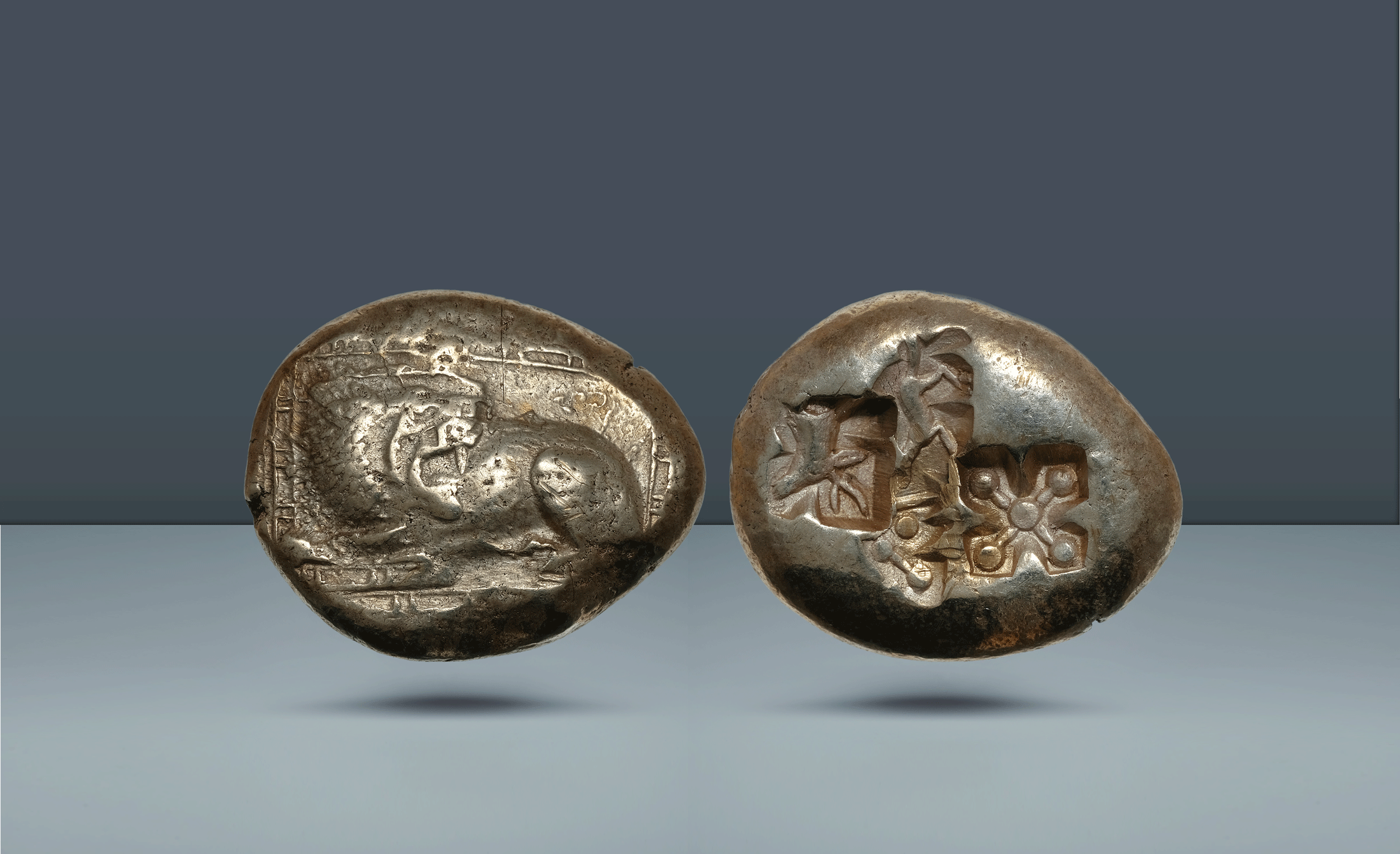
Ionia, Miletos. c. 600-546 BC
EL stater, 14.03g (20mm, n/a).
Roaring lion recumbent to l., his head turned back to r., all within an ornamental, rectangular lattice frame. / Three ornamental incuses; to l., a square punch containing a star of five pellets connected by lines; at the center, vertically, a rectangular punch containing a fox running to l. toward an ornament of three pellets; to r., a square punch, containing a stag's head to r.
Pedigree: The Peter Bartlett Collection. Purchased from CNG.
References: SNG Kayhan 440. Hilbert Phase 2, S30 (dies A16/G23). Weidauer 126. Konuk & Lorber fig. 18
Grade: Lion is partially off flan due to flan irregularity. Minor die wear on obverse. Reverse is lovely and without issue. There are two extremely rare countermarks of a stag and fox which makes this all the more interesting. Good VF+/EF
gk2135
Scroll down for more information about this coin.
Struck between roughly 600 and 546 BCE on the Milesian standard at approximately 14 grams, this stater exemplifies the multi-punch system that defined electrum coinage across Ionia and Lydia during the formative decades of struck coinage. The mechanics worked as follows: rather than placing the heated flan between two engraved dies, the mint worker positioned multiple iron punches on top of the blank, which then sat on the fixed obverse die. A single hammer blow drove all the punches downward simultaneously, forcing the metal into the obverse die below while leaving the individual punch impressions on the reverse. As such, the resulting reverse displays distinct, separated incuse fields rather than a unified design.
That being said, this approach offered several technical advantages over later paired dies. Notably, distributing the hammer force across multiple smaller punches rather than one large die reduced stress on any single tool, significantly extending working life. In addition, individual punches could be replaced or rotated as they wore out without retiring the entire reverse apparatus - a meaningful efficiency in an era when die-cutting was a labor-intensive specialty. Furthermore, the smaller contact area of each punch concentrated downward force more effectively, producing deeper, sharper obverse impressions in the unforgiving electrum alloy. However, this system inevitably produced irregular reverses, with punch placement varying from coin to coin - a limitation that would drive the eventual transition to proper two-die striking.