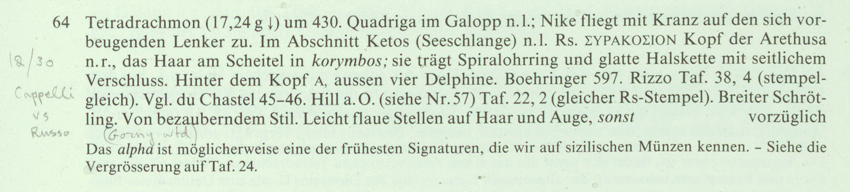
Sicily, Syracuse. c. 440 BC
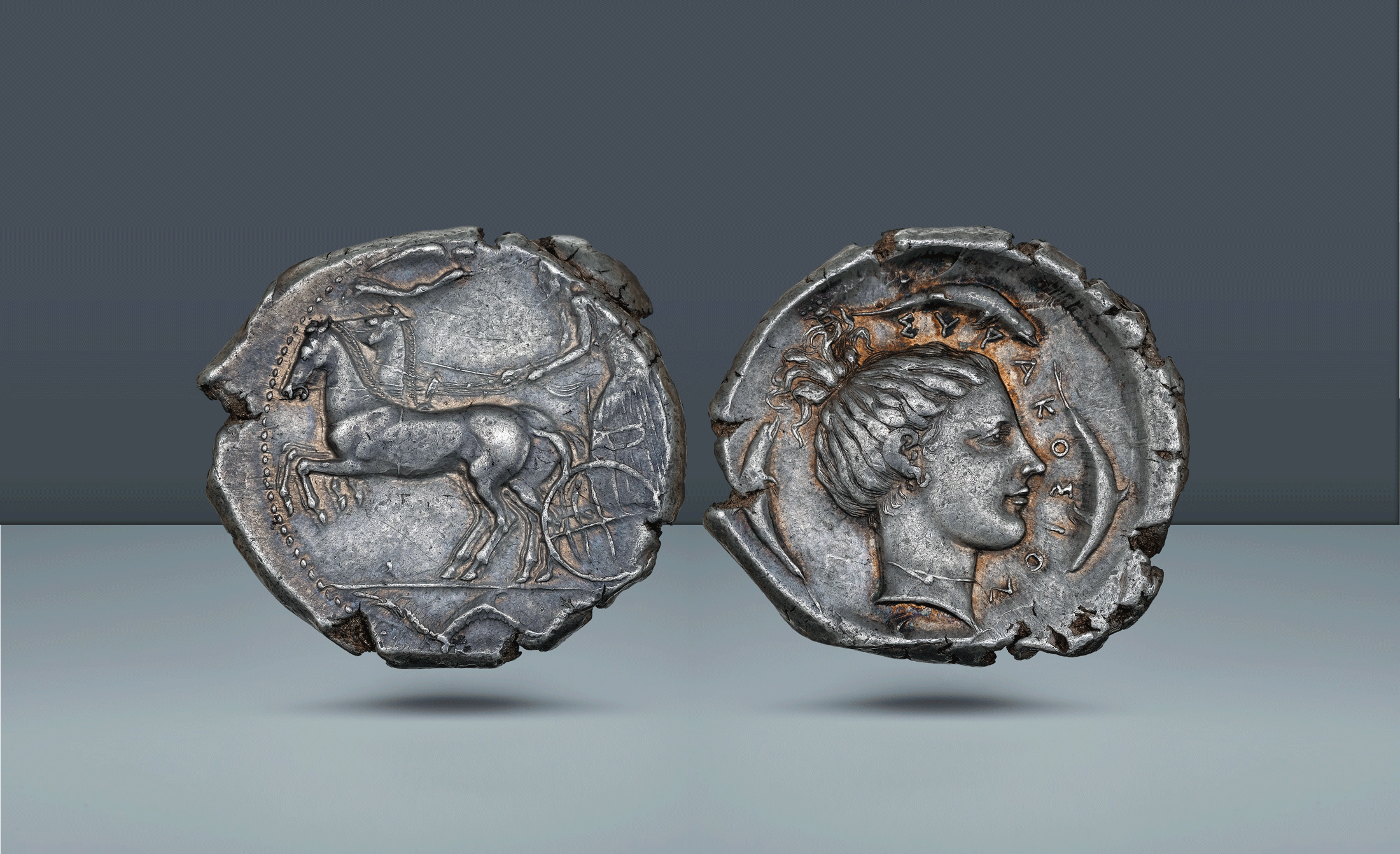
Sicily, Syracuse. c. 440 BC
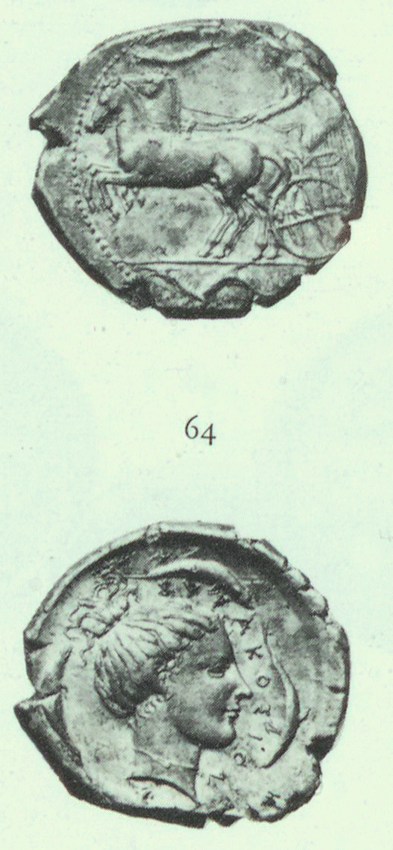
AR Tetradrachm, 17.24g (29mm, 6h).
Fast quadriga l., the standing driver, wearing sleeveless chiton, holding the reins with both his hands, the kentron in his r. hand; above, Nike flying r. to crown him; in exergue, ketos (seamonster) l. / ΣYPAKOΣION Head of girlish Arethusa r., the hair in a krobylos on the top of the head; she wears an earring and a necklace; around, four dolphins swimming clockwise; in lower l. field, faint letter A.
Pedigree: Bank Leu AG, Zurich 36 (1985), lot 64. Auction F. Sternberg, Zurich 20 1988), lot 363. Auctions Numismatica Ars Classica AG, Zurich 9 (1996), 211 and 18 (2000), lot 123
References: Boehringer, Syrakus 224, 597 (same dies); SNG ANS 195 (same dies); Antikenmuseum Basel 127, 444 (same obv. die).
Grade: Obverse is slightly o/c so that the head of the charioteer and the nike are partially off flan. Some cracking on the edges. The reverse is lovely with a fine Arethusa style with her hair up and flowing. A beautiful strike iridescent toning and a good pedigree. aEF/Toned EF+
gk2176
Scroll down for more information about this coin.
This tetradrachm belongs to the classic period of Syracusan die-engraving, struck at the height of the city's wealth and civic confidence in the decades following the defeat of the Carthaginians at Himera and the consolidation of Deinomenid and, later, democratic Syracuse as the dominant power in Sicily. The obverse captures a moment of triumphant motion: a fast quadriga driven left, the charioteer standing in sleeveless chiton, reins gathered in both hands and kentron poised in his right, while above him Nike descends in flight to crown the victor - a composition that transforms the coin into a miniature monument to athletic and civic victory, likely commemorating success in the great Panhellenic games. Below, in the exergue, a ketos, or sea-monster, coils beneath the horses' hooves, a device closely associated with the Syracusan mint and one that situates the scene within the city's maritime identity even as the chariot race itself speaks to landed aristocratic sport.
The reverse presents one of the most beloved images in all of Greek coinage: the girlish head of Arethusa, the nymph of the sacred spring on Ortygia around which Syracuse itself was founded, her hair swept up into a krobylos at the crown of her head, adorned with earring and necklace. Four dolphins circle her in clockwise motion, evoking both the fountain of Arethusa's mythical submarine passage from the Peloponnese to Sicily and the city's intimate relationship with the sea. The die-engraver responsible for this coin remains anonymous - the great masters Kimon and Euainetos, whose signed dies would later come to define the pinnacle of Syracusan numismatic art, were not active until roughly 415–390 BC, a full generation after this piece was struck. This tetradrachm therefore belongs to the unsigned, formative phase of the classical Syracusan style, when the dynamic "fast quadriga" and the increasingly refined, almost lyrical treatment of Arethusa's features were still being developed by nameless hands working within the mint's evolving artistic tradition - the very soil, in effect, from which the later signed masterpieces would grow. The fluency of the hair and the softness of the girlish features already anticipate the achievement that Kimon and Euainetos would bring to full flower a generation later.