
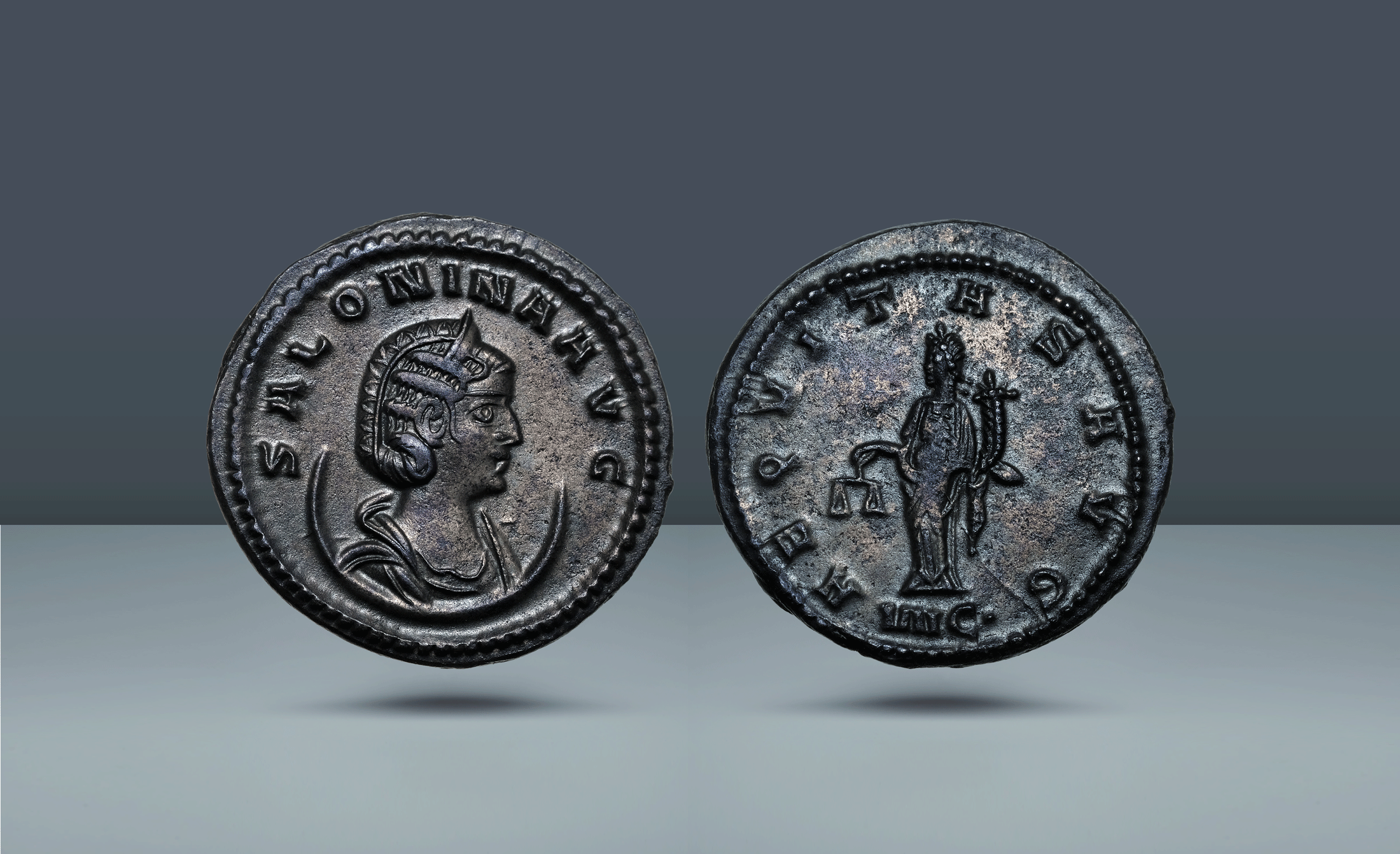
Roman Empire, Syria. Salonia as Augusta, 254 - 268 AD Antioch, 13th emission, c. 266 - 268 AD
Roman Empire, Syria. Salonia as Augusta, 254 - 268 AD Antioch, 13th emission, c. 266 - 268 AD
AR Antoninianus, 3.84g (22mm, 6h).
Draped bust r., wearing stephane and set on crescent / Aequitas standing l., holding scales and cornucopia; crescent in l. field; VIIC •
References: RIC 87; MIR 36, 1648d; RSC 4Grade: Nice large flan with good strike. EF
re1461
Scroll down for more information about this coin.
Salonia - full name Cornelia Salonina - was the wife of the emperor Gallienus and one of the most enduring imperial consorts of the turbulent third century. She stood beside her husband through nearly fifteen years of almost unrelenting crisis: barbarian invasions, internal usurpations, plague, and the gradual fragmentation of the empire during what historians now call the Crisis of the Third Century. Where many emperors of the era barely had time to strike coinage before being overthrown or killed, Salonia's long tenure as Augusta resulted in a relatively substantial and varied series of silver antoniniani - yet fine, well-preserved examples remain genuinely scarce.
This piece was struck at the important eastern mint of Antioch during the 13th emission, placing it in the final years of Gallienus's reign, 266–268 AD - just before both emperor and empress were killed in the military coup that brought Claudius II to power in 268. It is thus among the last coins struck in Salonia's name, from the twilight of a reign that had weathered more adversity than almost any other in Roman history.
The obverse shows a draped bust of Salonia facing right, wearing a stephane - the elegant diadem-crown associated with divine queenship - and set on a crescent, the latter a hallmark of the antoninianus denomination and a detail that lends the portrait an almost lunar, otherworldly quality. The reverse presents Aequitas, the personification of equity and fairness, standing left and holding her characteristic attributes of scales and cornucopia. A crescent appears in the left field, and the officina mark VIIC • identifies the specific workshop responsible for this issue. The reverse type was a deliberate statement of just and balanced governance - a pointed message in an era when imperial legitimacy was under constant challenge.