
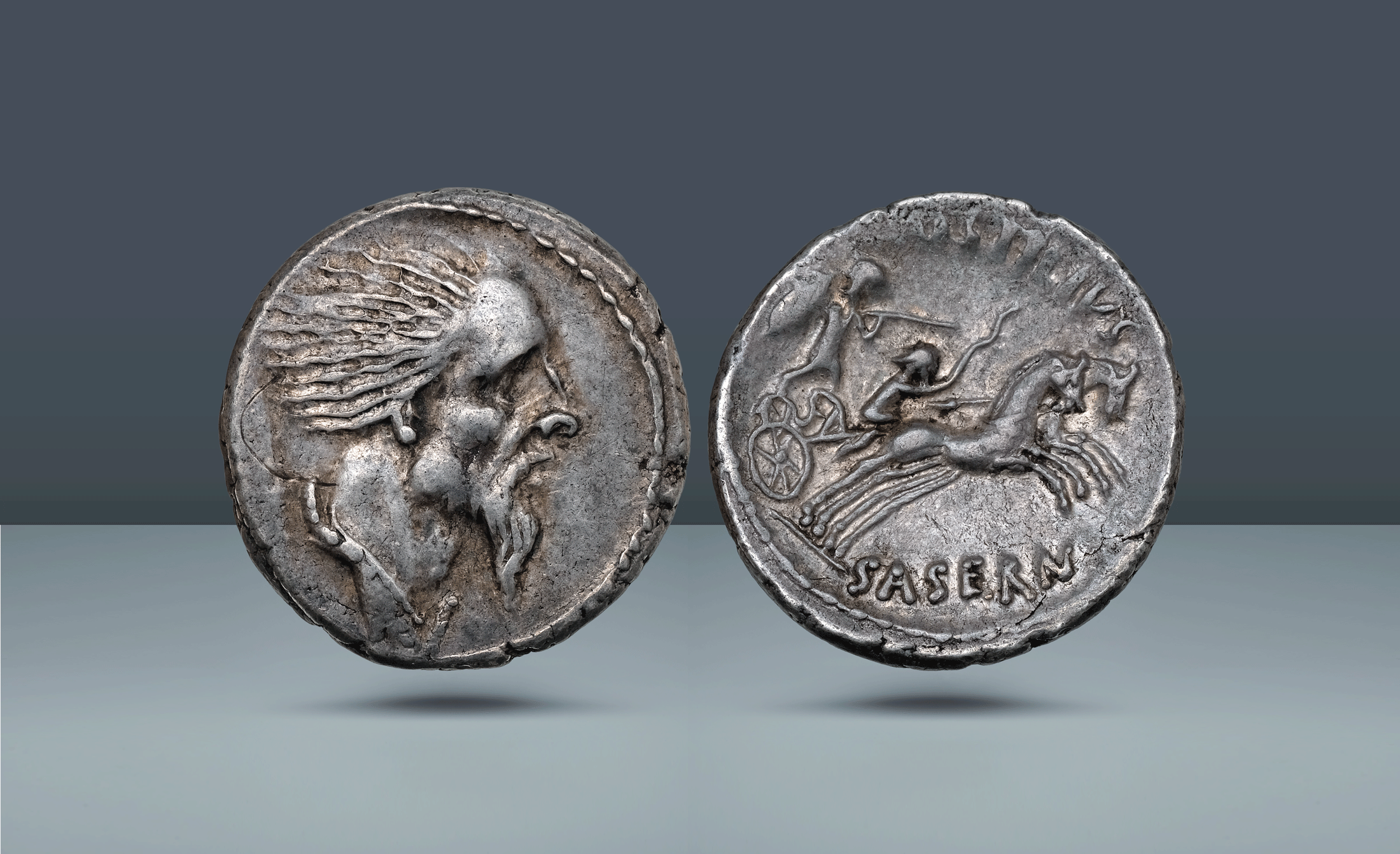
Roman Republic, Italy. L. Hostilius Saserna.
Rome, c. 48 BC, AR Denarius, 3.68g (18mm, 4h)
Draped male bust (Vercingetorix?) with wild hair and long plaited beard to r. / Nude Gallic warrior, holding shield and spear standing to l. in a galloping biga being driven to r. by a seated charioteer holding a whip
Pedigree: From the Bem Jamin Collection.
References: Babelon (Hostilia) 2. Crawford 448/2a. CRI 18. RBW 1569. Sydenham 952
Grade: Lovely and complete. Some iridescent toning. Minor wear on the top legend on reverse. EF
rr1425
Scroll down for more information about this coin.
This denarius was struck at Rome in 48 BC, during L. Hostilius Saserna’s term as one of the tresviri monetales. The obverse depicts a gaunt, bearded male head with long, unkempt hair and what appears to be a chain or rope around the neck. The reverse shows a naked warrior brandishing a spear and shield while standing in a two-horse chariot, with a charioteer driving the team. It is important to note that neither side carries a name. As such, the identification of the obverse figure as Vercingetorix is a modern interpretation rather than one attested in any ancient source.
The case for this identification rests largely on chronology. Vercingetorix, the Arvernian chieftain who led the Gallic revolt of 52 BC, surrendered to Caesar following the siege of Alesia. He was then held in Rome for six years before being displayed in Caesar's Gallic triumph of 46 BC and executed shortly afterwards. When Saserna's coins were struck, therefore, Vercingetorix was a prisoner in the city, a living symbol of Caesar's greatest victory.
Saserna's companion issue supports the same interpretation. Its obverse depicts a female head, generally identified as a personification of Gallia, with a carnyx, the Gallic war trumpet, behind her (Crawford, 1974, RRC 448/3). Read together, the two issues present a coherent programme celebrating the subjugation of Gaul. The chariot on the reverse of RRC 448/2 is also noteworthy. Caesar describes chariot warfare in detail in his account of the British campaigns, and the scene would have appeared distinctly foreign to a Roman audience.