Roman Republic, Italy. Anonymous, Rome, c. 225-212 BC
Roman Republic, Italy. Anonymous, Rome, c. 225-212 BC
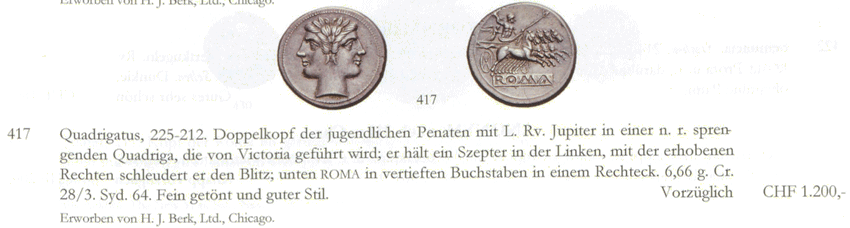
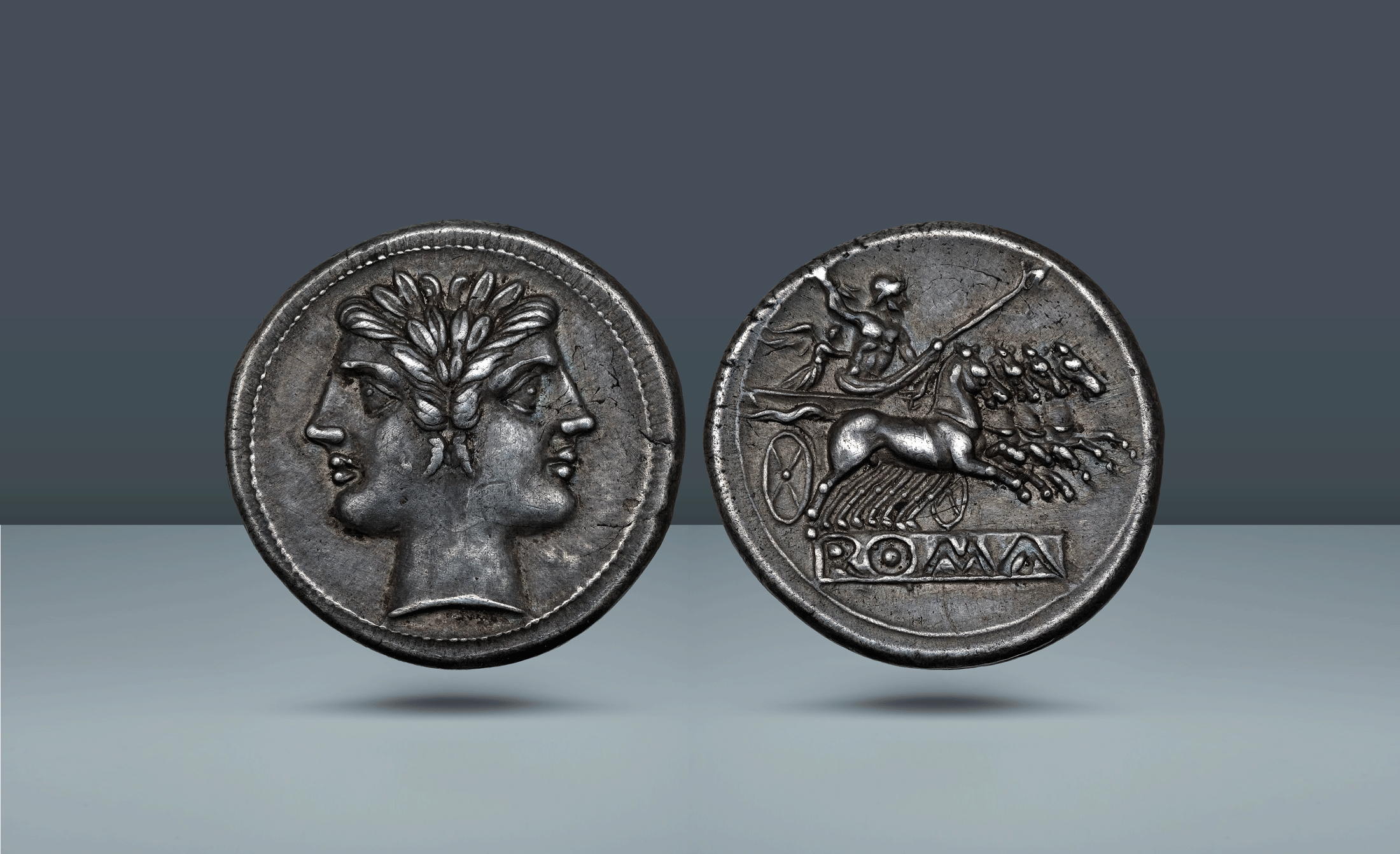
AR Didrachm - Quadrigatus,6.65g (22mm,5h ).
Laureate head of Janus, no annulets at top of head, curved truncation / Jupiter, hurling thunderbolt and holding scepter, in galloping quadriga driven right by Victory; ROMA incuse on raised tablet in exergue.
Pedigree: From the PLZ Collection. Ex Gasvoda Collection (Triton XXII, 8 January 2019), lot 780; Nomos FPL (Winter-Spring 2014), lot 34; Goldberg 72 (5 February 2013), lot 4116; Roma II (2 October 2011), lot 380; Hess-Divo 317 (27 October 2010), lot 417.
References: Crawford 28/3; Sydenham 64a; HN Italy 334; RSC 23; RBW 65.
Grade: Beautifully struck with cabinet toning. Mint State
rr1401
Scroll down for more information about this coin.
The silver quadrigatus, Rome's principal coin of the late third century BC, carries one of the most compelling obverses in Republican numismatics: a youthful janiform head, two faces gazing in opposite directions. The type draws on a rich body of ancient testimony explaining why this god belonged on Roman money.
The most direct account comes from Macrobius (Saturnalia 1.7.21–22), who preserves the tradition that Janus welcomed Saturn to Italy when the god arrived by ship, learned agriculture from him, and rewarded him with a share of his kingship, and that when Janus struck the first coins, he stamped his own likeness upon them. To Roman eyes, the mythical inventor of coinage was the natural face of the coinage itself. In Ovid's Fasti (Book 1), Janus appears in person, explaining his double countenance and his dominion over beginnings, thresholds, and the turning year, a fitting patron for a state launching a new national silver coinage. Pliny the Elder (Natural History 34.16) adds that the double Janus was consecrated by King Numa and worshipped in matters of both peace and war, symbolism that resonated powerfully on a coin struck to finance the struggle against Hannibal. Plutarch, meanwhile, connects the two faces to concord: after Romulus and Titus Tatius made their compact, a two-faced statue of Janus represented the two peoples united.
Interestingly, because the quadrigatus head is beardless while Janus was conventionally bearded, there are some scholars who identify the faces instead as the Dioscuri. Either way, the type proclaimed divine guardianship over Rome at its moment of greatest peril.