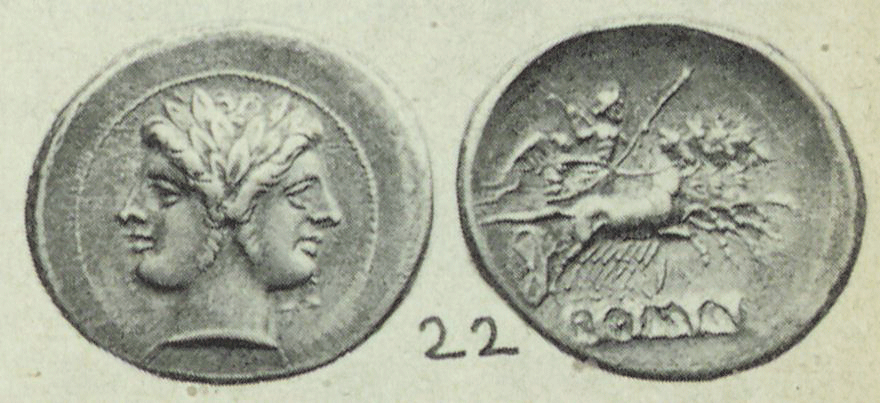
Roman Republic, Italy. Anonymous, Rome, c. 225-212 BC
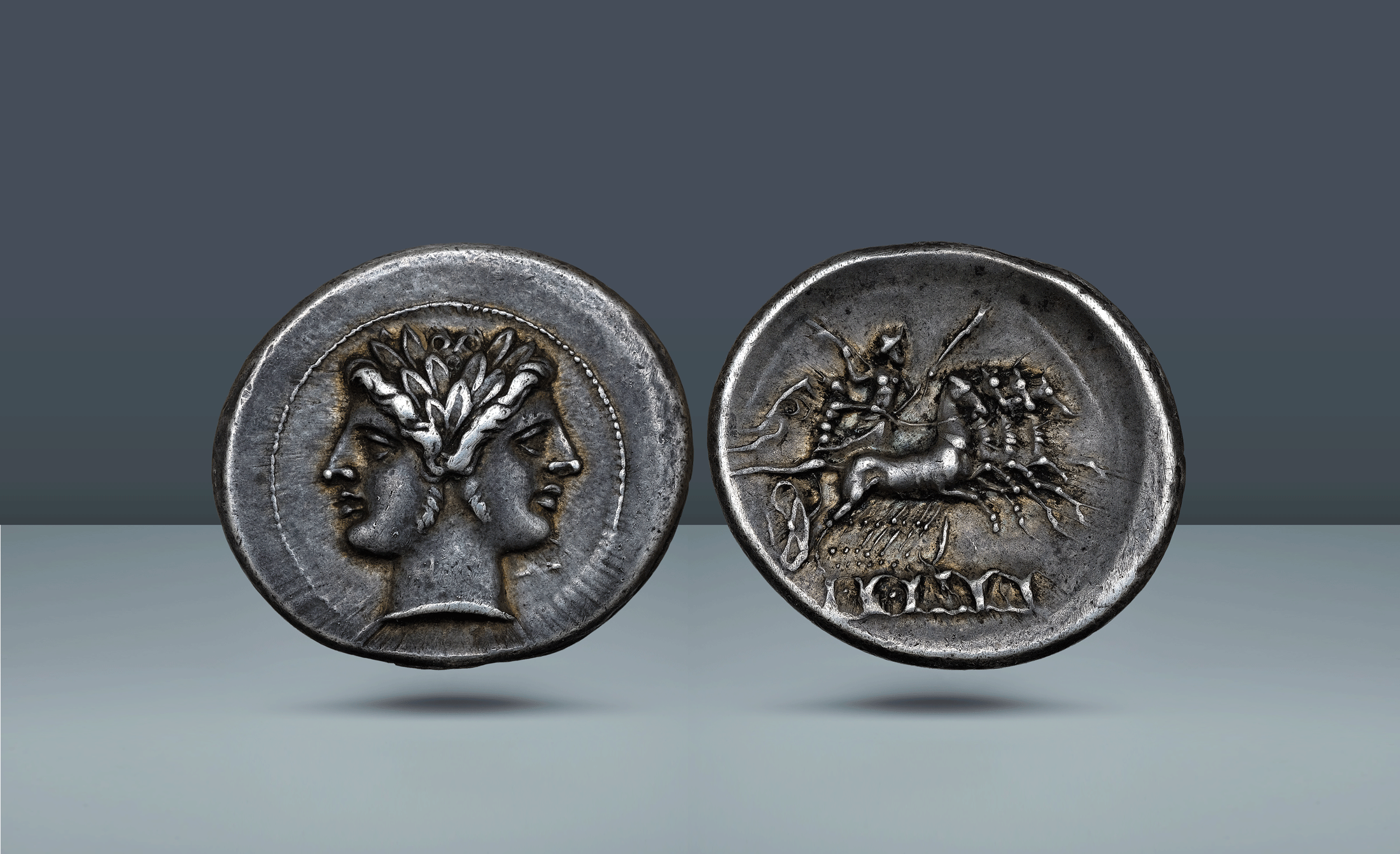
Roman Republic, Italy. Anonymous, Rome, c. 225-212 BC
AR Didrachm - Quadrigatus,6.65g (26mm,6h ).
Laureate head of Janus, annulets at top of head, curved truncation / Jupiter, hurling thunderbolt and holding scepter, in galloping quadriga driven right by Victory; ROMA incuse on raised tablet in exergue.
Pedigree: From the Thomas Palmer Collection, purchased from Freeman & Sear, 2006. Ex A. Lynn Collection (Coin Galleries, 16 February 2000), lot 125; Leo Benz Collection (Lanz 88, 23 November 1998), lot 39; Münzen und Medaillen AG FPL 260 (December 1965/January 1966), lot 22
References: Crawford 28/3; Sydenham 64a; RSC 23; RBW 63.
Grade: Beautifully struck with some iridescent toning. Border is blurred on the obverse at bottom. Large flan and EF
rr1402
Scroll down for more information about this coin.
Originally Rome's native money tradition was bronze, and consisted of large unwieldy cast aes grave weighed by the pound. While that worked for a local Italian economy, contact with the Greeks and the Greek colonies of Campania and southern Italy created the need for silver coinage. Southern Italy ran on the Greek didrachm standard, so if Rome wanted to hire, pay, and trade in that world, it needed silver on a familiar weight and purity. Accordingly, the quadrigatus weighed about 6.5-6.8 grams, consistent with the weight of a south Italian Greek didrachm.
The second driver was war finance. The quadrigatus was produced in large quantities starting around 235 BC and struck for about two decades, becoming increasingly debased. During the Second Punic War it eventually dropped to as little as 30% silver. That debasement is ultimately what killed it. By 211 BC Rome faced severe financial pressure and the old didrachm system had become impractical, so the state scrapped it for a fresh, trustworthy coin. Thus was the denarius born.