
Aegina, c. 545-525/15 BC
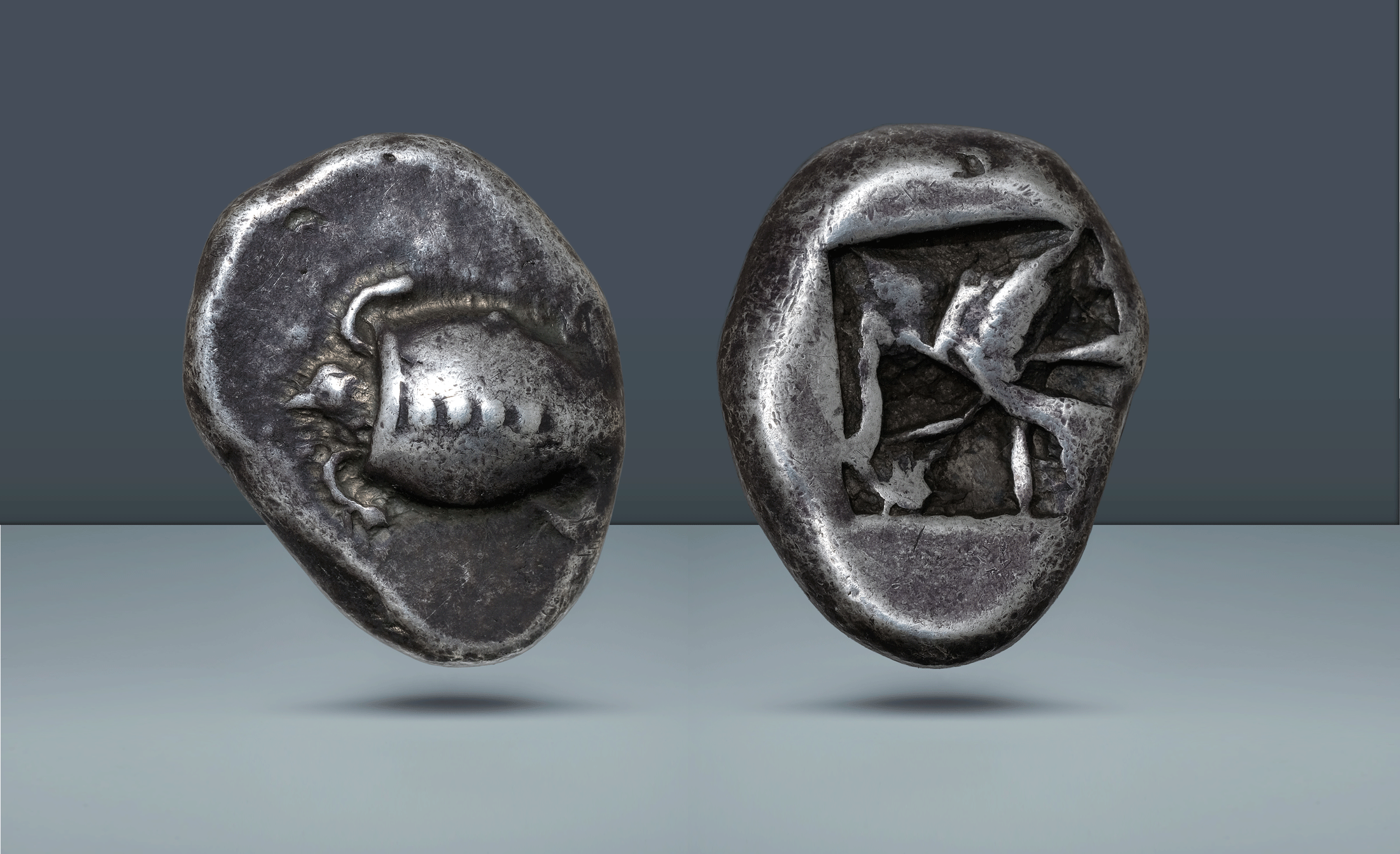
Aegina, c. 545-525/15 BC
AR Stater, 12.20g (na)
Sea turtle / Crude square incuse
Pedigree: From the personal collection of Harlan J. Berk and a plate coin in his 100 Greatest Ancient Coins, Volumes 1, 2 and 3
References: Milbank 1, Asyut 424 (Group I). Berk, 100 Greatest Ancient Coins, Volume 3, pg. 60 (this coin)
Grade: Earliest of the Milbank issues. This coin is a plate coin in all three of Harlan J. Berk's 100 Greatest Ancient Coins. Toned EF
gk2218
Scroll down for more information about this coin.
Few coins can claim a place as near to the beginning of European coinage as the sea turtle staters of Aegina. The small island in the Saronic Gulf, within sight of both Athens and the Peloponnese, was among the first states of mainland Greece to strike silver, and ancient writers credited it with that distinction. Ephorus, as preserved by Strabo, attributed the first Aeginetan silver to Pheidon of Argos, and whatever the historical truth of that tradition, it shows that later Greeks regarded these coins as the origin point of money in their world. The weight standard Aegina established, with its stater of roughly 12.2 grams, became one of the great systems of the Greek world, adopted across the Peloponnese, Central Greece, the Cyclades, and Crete, and in use for centuries.
Aegina's prosperity rested on the sea. Lacking a large agricultural hinterland, the Aeginetans became merchants and carriers. Herodotus names the Aeginetan Sostratos as the most successful trader of his day, and records that Aegina alone among the mainland states kept its own sanctuary at Naukratis, the Greek trading port in Egypt. The marine turtle was a fitting emblem for such a people, and their coins traveled as far as their ships did. The present example is recorded in the Asyut hoard, the great deposit of archaic silver buried in Upper Egypt in the early fifth century BC and published by Price and Waggoner. That hoard gave scholars a firm framework for arranging the earliest Greek coinages, and this coin is placed in its Group I, the opening phase of the Aeginetan series. It is likewise Milbank 1, the first entry in Samuel Milbank's foundational study of the mint, making it the earliest of the Milbank issues. The crude, irregular square incuse on the reverse is the purest expression of the punch that drove the flan into the obverse die, before Aegina's engravers developed the divided and skew patterns of later issues. The sea turtle itself would remain the city's badge until the mid-fifth century, when Aegina fell to Athens and the type changed to a land tortoise, a shift often read as a mark of the island's lost maritime independence.
This coin has a distinguished modern history of its own. It is a plate coin in all three volumes of Harlan J. Berk's 100 Greatest Ancient Coins, and appears in Volume 3 on page 60, a rare record of continuous recognition as a definitive example of one of antiquity's most celebrated types. Struck on a full, heavy flan and carrying attractive toning, it offers the collector both a foundation stone of Greek coinage and a specimen of documented standing.