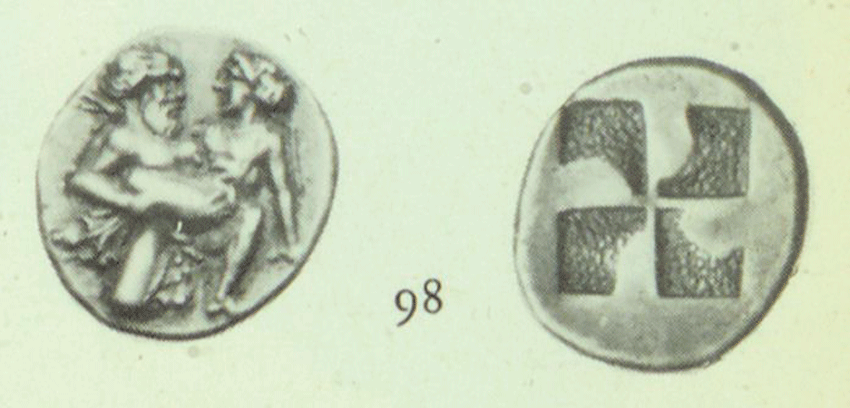
Islands off Thrace, Thasos. c. 412-404 BC
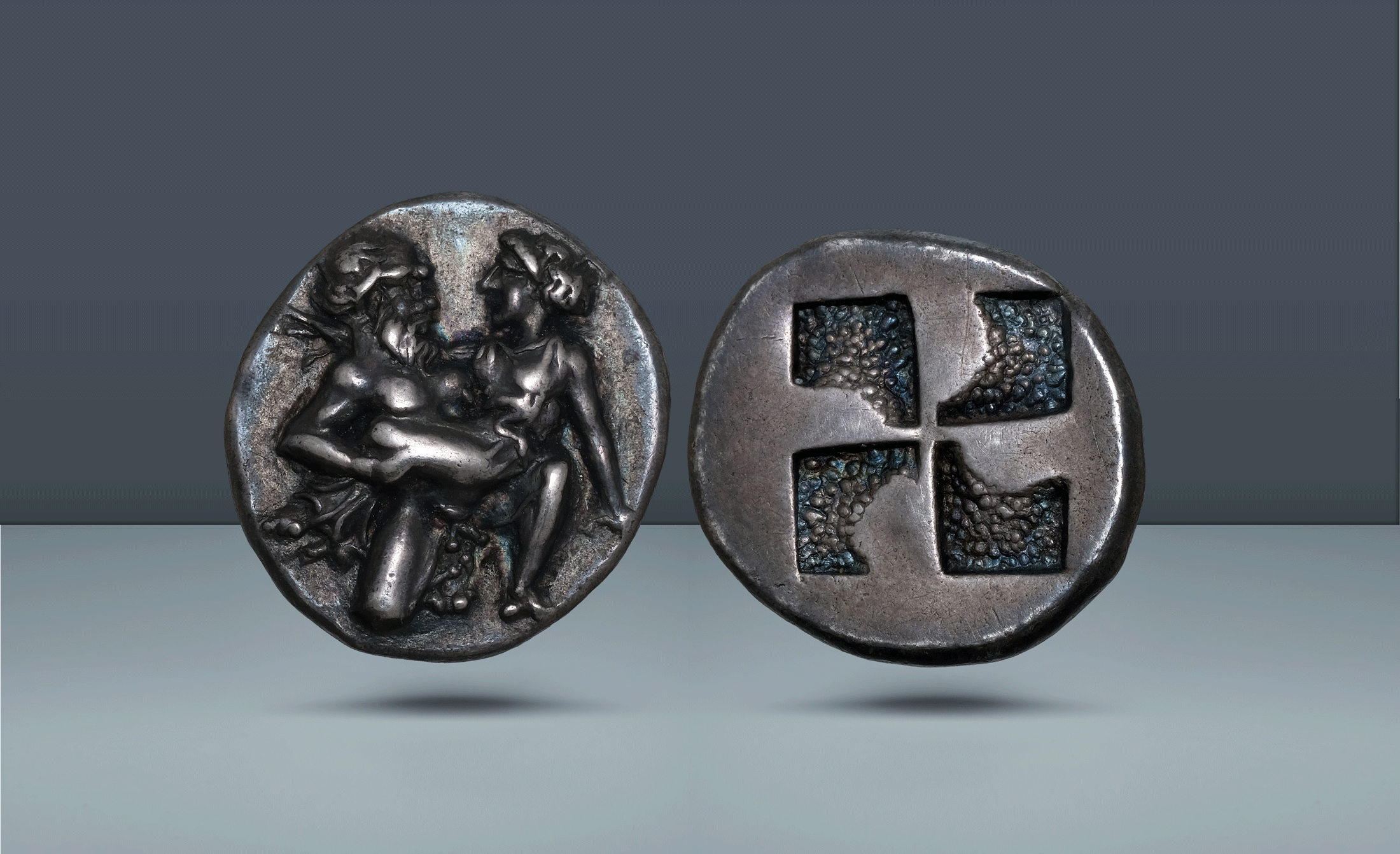
Islands off Thrace, Thasos. c. 412-404 BC
AR Trite, 3.46g (15.75mm, n/a)
Elderly ithyphallic satyr advancing to r., carrying protesting nymph. / Quadripartite incuse square
Pedigree: Ex Bank Leu 33, 1983, lot 269; Adolph Hess & Bank Leu 49, 1971, lot 98. Reportedly acquired privately from Tradart. From the Raul Abecassis (1905-1977) and Jules Desneux (1885-1962) collections
References: Le Rider 8, SNG Copenhagen 1019
Grade: One of the nicest examples we have ever handled. Exquisite pedigree. High relief, cabinet toning and iridescent undertones. Reverse incuse is also fully struck with details. FDC
gk2172
Scroll down for more information about this coin
Settled by colonists from Paros in the early seventh century BC, among them the soldier-poet Archilochus, Thasos grew into one of the wealthiest communities of the northern Aegean. Herodotus records the remarkable revenues the Thasians drew from the gold mines on the island and from their holdings on the Thracian mainland opposite, and the island was equally renowned for its wine, which travelled across the Greek world in distinctive stamped amphorae. The cult of Dionysus stood at the heart of Thasian civic life, and it is fitting that the city's silver should for generations have carried a scene from the god's riotous retinue.
The satyr and nymph type first appeared on Thasian coinage in the later sixth century, and over the following hundred years it evolved from the stiff, stylized figures of the Archaic period into the supple, naturalistic compositions seen here. On this trite an elderly, bearded satyr strides to the right, bearing a nymph in his arms who raises her hand in protest against her abductor. The engraver has handled the tangle of limbs with real assurance, giving the satyr a convincing sense of forward motion and the nymph an animated resistance, all within a flan of modest size. The reverse retains the quadripartite incuse square inherited from earlier issues. These closing years of the fifth century were turbulent ones for the island, which broke from the Athenian alliance in 411 BC amid the upheavals of the Peloponnesian War, yet the mint's output remained of the highest quality.
This is a coin of exceptional preservation, struck in high relief on a full flan and carrying a lovely cabinet tone with iridescent undertones. Unusually, the reverse incuse is also fully struck and retains its internal detail, a feature rarely encountered on the type. Its provenance is equally distinguished, passing through two landmark Swiss sales, the 1971 Hess-Leu auction and Bank Leu 33 in 1983, and a lineage reaching back to the collections of Raul Abecassis and Jules Desneux. One of the finest examples we have handled, combining superb artistry, outstanding condition and a noteworthy chain of ownership.